
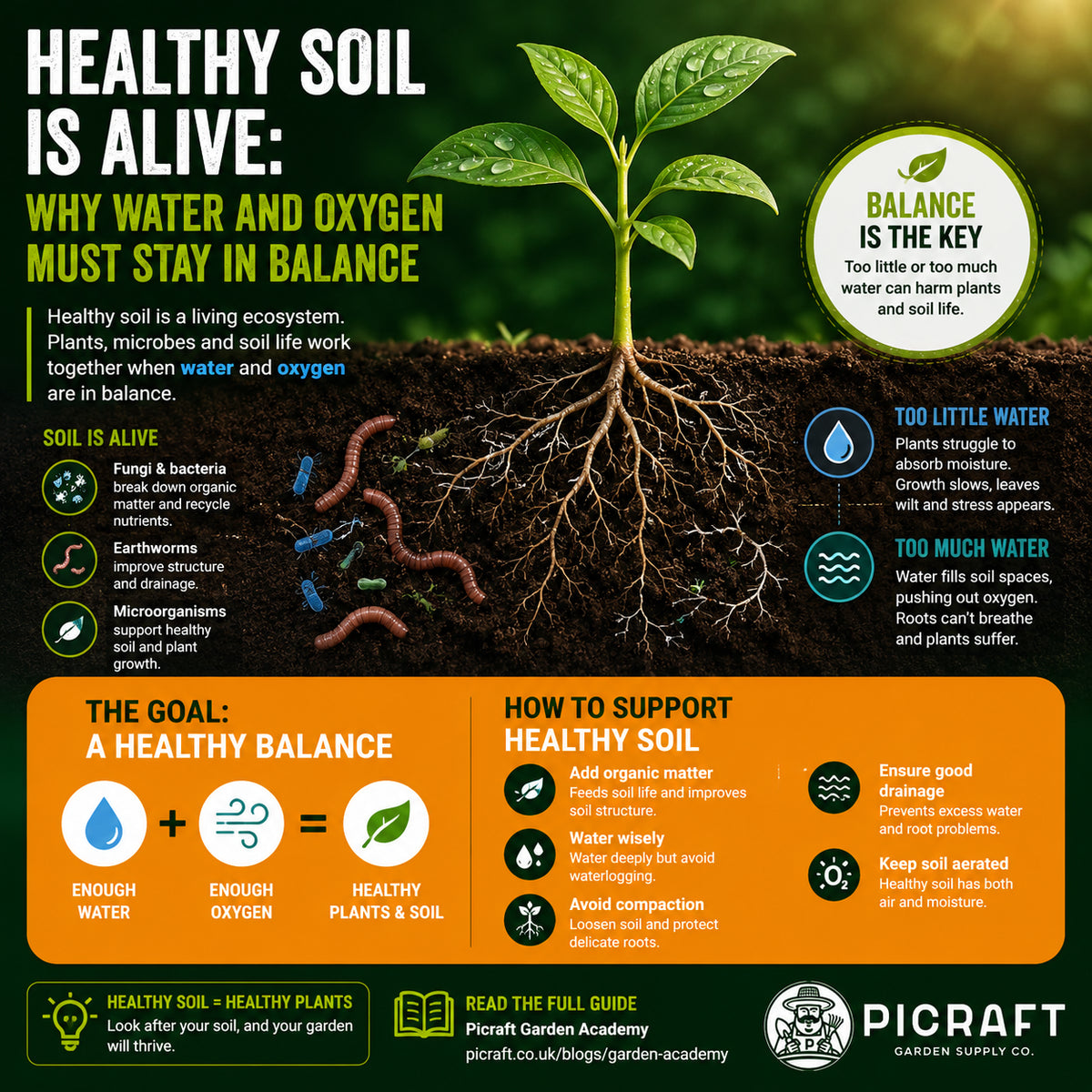
Healthy Soil Is Alive: Why Water and Oxygen Must Stay in Balance
When we look at a garden, most of our attention naturally goes to what we can see.
Green leaves. Flowers. Vegetables. Lawns. Trees and shrubs.
But beneath all of that is an environment that's just as important:
the soil.
Healthy garden soil isn't simply dirt holding plants upright. It's a complex living ecosystem containing roots, fungi, bacteria, earthworms and countless other organisms.
And all of them depend on the conditions underground.
One of the most important things to understand is that healthy soil needs more than water.
It needs water and oxygen in balance.
Too little water creates one set of problems.
Too much water can create another.
Understanding that balance can help you grow healthier plants, improve your soil and avoid one of the most common gardening mistakes: assuming that a struggling plant always needs more water.
Quick Answer: Why Does Healthy Soil Need Water and Oxygen?
Plant roots require water, but they also require oxygen for respiration.
Healthy soil contains tiny spaces known as pores between soil particles and aggregates. These spaces can contain both water and air.
When conditions are suitable, roots have access to:
💧 moisture;
💨 oxygen;
🌱 nutrients;
🦠 a functioning soil ecosystem.
If soil becomes excessively dry, plants struggle to obtain sufficient water.
But if soil remains saturated for too long, water occupies much of the pore space that would otherwise contain air.
That can reduce the oxygen available to roots.
The goal therefore isn't:
keep the soil as wet as possible.
It's:
maintain suitable moisture while allowing the root zone to remain adequately aerated.
Healthy Soil Is a Living Ecosystem
A handful of healthy garden soil can contain an extraordinary biological community.
It may include:
- bacteria;
- fungi;
- protozoa;
- nematodes;
- earthworms;
- insects and other small organisms;
- living plant roots.
These organisms interact with organic matter, minerals, water and each other.
Some help break down dead plant material.
Others participate in nutrient cycling.
Earthworms can influence soil structure through their movement and feeding.
Fungi can form important relationships with plant roots.
This is why it's useful to stop thinking about soil simply as something plants grow in.
Soil is an ecosystem in its own right.
And like any ecosystem, its physical conditions matter.
What's Actually Inside Garden Soil?
At first glance, soil looks solid.
But healthy soil contains a network of tiny spaces.
These spaces — or pores — are extremely important.
Some can contain water.
Others can contain air.
That combination creates an environment in which roots can obtain moisture while still having access to oxygen.
Think of healthy soil less like a solid block and more like a complex sponge-like structure.
Its ability to hold and move both air and water is a major part of what makes it suitable for plant growth.
This is also why soil structure matters so much.
Why Do Plant Roots Need Oxygen?
It's easy to associate plants with carbon dioxide because leaves take in CO₂ for photosynthesis.
But plant roots are living tissues too.
Their cells carry out respiration, a process that requires oxygen to release usable energy.
That energy supports essential functions including growth and nutrient uptake.
Roots obtain much of this oxygen from air present within soil pore spaces.
This gives us an important gardening principle:
Plants need water around their roots — but they also need air.
That's why permanently saturated soil can become a problem.
What Happens When Soil Has Too Little Water?
When soil becomes increasingly dry, the amount of water available to plant roots decreases.
Initially, you may not notice anything dramatic above ground.
But the plant can already be responding.
As water becomes harder to obtain, plants may begin conserving it.
Growth can slow.
Stomata in the leaves may close more frequently, reducing water loss but also restricting carbon dioxide intake.
If the situation continues, symptoms can become more obvious.
These may include:
- wilting;
- dry or curling leaves;
- reduced growth;
- fewer flowers;
- smaller fruits or vegetables;
- premature leaf drop.
One important lesson is that visible wilting isn't necessarily the beginning of water stress.
By the time a plant is dramatically wilted, it may already have been experiencing difficult conditions for some time.
What Happens When Soil Has Too Much Water?
This is where gardening can become counterintuitive.
If water is essential for plants, surely more water should be safer than too little?
Unfortunately, it doesn't work that way.
When soil becomes saturated, water fills more of its pore spaces.
If those conditions persist, less air may remain available within the root zone.
That means roots can experience reduced oxygen availability.
Poorly aerated conditions can interfere with healthy root function and contribute to root problems.
Possible signs can include:
- yellowing leaves;
- weak or slow growth;
- wilting;
- persistently wet soil;
- unhealthy roots.
And here's the trap:
Some of those symptoms can also appear when a plant is short of water.
So a gardener sees a wilted or yellowing plant and responds by watering it again.
If excessive moisture was already the problem, that can make conditions worse.
Why Can an Overwatered Plant Look Thirsty?
This confuses many gardeners.
You might think:
"If the leaves are wilting, the plant must need water."
But wilting fundamentally means that plant cells aren't maintaining their normal water pressure effectively.
That can happen because there isn't enough water available in the soil.
But root problems can also interfere with the plant's ability to take up water effectively.
So the appearance of the leaves alone doesn't always tell you what's happening underground.
Before reaching for the hose, check the soil.
That's one of the simplest improvements you can make to your watering routine.
Watering Is Not the Same as Soil Moisture
This connects directly with another principle we've discussed in the Picraft Garden Academy.
Watering is something you do.
Soil moisture is the condition you create.
You might water two gardens for exactly ten minutes.
But if one has sandy soil and the other has heavy clay, the conditions underground can be very different afterwards.
Sandy soil generally drains more quickly.
Clay-rich soil generally retains water for longer.
So the question shouldn't simply be:
"When did I last water?"
A much better question is:
"What are the conditions in the root zone right now?"
Why Soil Type Changes the Water–Oxygen Balance
Different soils contain different particle sizes and pore structures.
That influences both water retention and drainage.
Sandy Soil
Sandy soils contain relatively large particles and tend to have larger pore spaces.
They usually:
- drain quickly;
- provide good aeration;
- retain less water.
The challenge can therefore be keeping enough useful moisture available to plants.
Clay Soil
Clay contains extremely small particles and can retain much more water.
Clay soils generally:
- hold moisture for longer;
- drain more slowly;
- can become poorly aerated when saturated or compacted.
The challenge can therefore be avoiding prolonged waterlogging while maintaining good soil structure.
Loam Soil
Loam usually contains a mixture of particle sizes and can provide a useful balance between:
water retention + drainage + aeration.
But even good loam can become compacted or poorly drained.
So soil type is only part of the story.
Why Soil Compaction Matters
Imagine squeezing a sponge.
Its structure changes and the spaces inside become smaller.
Something conceptually similar can happen when garden soil becomes heavily compacted.
Compaction reduces pore space and can make it more difficult for:
- air to move through the soil;
- water to infiltrate effectively;
- roots to expand;
- soil organisms to function normally.
Compaction can be caused by repeated foot traffic, machinery, working wet soil and other forms of pressure.
This is particularly important around established plants.
Healthy roots need somewhere to grow.
If the soil becomes dense and poorly structured, both root development and water movement can be affected.
How Can You Avoid Soil Compaction?
A few practical habits can help.
Avoid repeatedly walking over growing areas where possible.
Use defined paths around beds.
Try not to work heavy soil when it is extremely wet.
Be careful with heavy machinery around root zones.
And support good soil structure through appropriate organic matter management.
The aim isn't to make soil permanently loose and fluffy.
It's to maintain a structure that allows roots, water and air to move through it effectively.
Why Organic Matter Is So Important
Organic matter can play a major role in healthy garden soil.
Materials such as well-rotted compost can contribute to soil structure and provide resources for soil organisms.
Over time, appropriate additions of organic matter can help improve the physical characteristics of many soils.
In sandy soils, organic matter can help improve moisture retention.
In heavier soils, it can contribute to improved structure.
And importantly, organic material provides food for many organisms involved in the soil ecosystem.
This is why compost isn't simply "plant food".
It's part of managing the environment in which plant roots live.
Earthworms: Gardeners Working Underground
Earthworms are one of the most visible members of the soil ecosystem.
As they move through soil, they create channels and interact with organic material.
Their activity can contribute to:
- soil structure;
- aeration;
- water movement;
- decomposition and nutrient cycling.
Finding earthworms isn't a perfect scientific test of soil health, but their presence is often a welcome sign of biological activity.
And they're a useful reminder that soil isn't an inert substance.
There's a lot happening beneath your feet.
What Do Fungi and Bacteria Do in Soil?
Soil microorganisms perform an enormous range of functions.
Many bacteria and fungi participate in breaking down organic material and cycling nutrients.
Some fungi also form close associations with plant roots.
These relationships can increase the effective area through which plants interact with the surrounding soil.
The underground ecosystem is therefore highly interconnected:
plants influence soil organisms, and soil organisms influence the environment available to plants.
This is one reason healthy soil management tends to focus on the whole system rather than individual components.
Drainage: Where Does Excess Water Go?
Good watering means more than getting water into the soil.
You also need to consider what happens afterwards.
If excess water has nowhere to go, the root zone may remain saturated for prolonged periods.
Drainage problems can result from several factors, including:
- naturally heavy soil;
- compaction;
- low-lying areas;
- poor soil structure;
- unsuitable containers;
- blocked drainage holes.
If part of your garden remains wet long after surrounding areas have drained, that can be a clue that drainage deserves attention.
Simply reducing watering may help, but persistent drainage problems sometimes require addressing the underlying soil or site conditions.
Containers Need Water and Oxygen Too
The same principles apply to pots, planters and containers.
In fact, drainage can be even more obvious there because roots are confined to a small volume.
A container needs to retain enough moisture for the plant while allowing excess water to escape.
That's why appropriate drainage holes are so important.
If water continuously accumulates at the bottom of a container, the lower root zone may remain saturated.
On the other hand, small containers can dry extremely quickly during hot or windy weather.
Again:
balance is the goal.
Mulch Can Help Manage Soil Moisture
Mulching can help reduce moisture loss from the soil surface.
Suitable mulch can:
- reduce evaporation;
- moderate soil temperature;
- suppress some weed growth;
- contribute organic matter over time, depending on the material.
This can help create more stable moisture conditions.
But mulch doesn't mean you can stop checking the soil.
It changes how quickly moisture is lost — it doesn't remove the need to understand what's happening in the root zone.
Don't Judge Soil by the Surface Alone
The uppermost layer of soil is exposed directly to:
☀️ sunlight;
💨 wind;
🌡️ warm air;
and therefore often dries first.
That means the surface can appear dry while soil several centimetres below still contains useful moisture.
The opposite can also happen.
A brief shower can make the surface look wet without providing meaningful moisture deeper in the root zone.
Before watering, check beneath the surface.
For many gardeners, that simple habit can prevent both unnecessary watering and accidental underwatering.
How to Support Healthy Soil
You don't need to turn gardening into laboratory science.
A few principles cover most of what matters.
1. Water according to conditions
Don't water simply because it's Tuesday.
Consider soil moisture, rainfall, weather, plant requirements and soil type.
2. Avoid prolonged waterlogging
If soil remains saturated for long periods, investigate drainage and watering frequency.
3. Protect soil structure
Reduce unnecessary compaction and avoid repeatedly walking over growing areas.
4. Add appropriate organic matter
Compost and other suitable organic materials can support soil structure and biological activity.
5. Keep the soil covered where appropriate
Plants and suitable mulches can protect the soil surface and help moderate moisture loss.
6. Look beneath the surface
The condition of the root zone matters more than whether the upper centimetre looks wet or dry.
The Water–Air Balance in Simple Terms
Think of soil as containing countless tiny spaces.
Healthy conditions might look conceptually like this:
SOIL PARTICLES + WATER + AIR = ROOT ENVIRONMENT
When the soil becomes too dry:
less available water → plant water stress
When it remains saturated:
too much water in pore spaces → less available air
The ideal balance changes depending on:
- plant species;
- soil type;
- temperature;
- season;
- root depth;
- rainfall;
- drainage.
That's why there is no universal watering schedule that works for every garden.
Healthy Soil vs Waterlogged Soil
| Healthy Soil Conditions | Waterlogged Conditions |
|---|---|
| Contains both moisture and air | Many pore spaces remain filled with water |
| Supports root respiration | Oxygen availability may decline |
| Allows appropriate water movement | Drainage may be slow |
| Supports active soil life | Some beneficial biological processes may be disrupted |
| Encourages healthy root development | Roots may become stressed |
| Moisture changes naturally over time | Soil remains saturated for prolonged periods |
The goal isn't dry soil.
And it isn't saturated soil.
It's a functioning root environment.
Frequently Asked Questions About Healthy Soil
Does soil need oxygen?
Yes. Plant roots require oxygen for respiration, and many organisms living in healthy soil also depend on aerated conditions.
Can soil have too much water?
Yes. When soil remains saturated for prolonged periods, water occupies pore spaces that would otherwise contain air. This can reduce oxygen availability around roots.
Why do plants need oxygen around their roots?
Root cells use oxygen during respiration to release energy needed for normal biological processes, including growth and nutrient uptake.
How do I know if my soil is waterlogged?
Persistently saturated soil, standing water, slow drainage and unhealthy plant growth can indicate a drainage or waterlogging problem.
Can overwatering cause yellow leaves?
It can. However, yellow leaves have many possible causes, so soil moisture and overall growing conditions should be checked before assuming overwatering is responsible.
Does dry-looking soil always need watering?
No. The surface can dry much faster than deeper layers. Check moisture below the surface before deciding whether to water.
Is compost good for soil structure?
Appropriate organic matter such as well-rotted compost can support soil structure, biological activity and moisture management.
Are earthworms good for garden soil?
Earthworms contribute to decomposition, nutrient cycling and soil structure through their movement and feeding activity.
Does clay soil contain less oxygen?
Not automatically, but clay-rich soil generally drains more slowly and can become poorly aerated when saturated or compacted.
Should garden soil always stay moist?
Not necessarily. Different plants have different requirements, and healthy soil normally experiences natural changes in moisture. The objective is to avoid damaging extremes rather than keeping soil permanently wet.
Healthy Plants Start Below the Surface
When a plant looks unhealthy, it's natural to focus on what you can see.
The leaves.
The flowers.
The stems.
But sometimes the most important question is:
What's happening underground?
Healthy soil needs moisture.
But healthy roots also need oxygen.
Soil organisms need a suitable environment.
Water needs to enter the soil, but excess water also needs somewhere to go.
And roots need enough space to grow and function.
That's why good soil management isn't about maximising one thing.
It's about balance.
💧 Enough water.
💨 Enough oxygen.
🌱 Good structure.
🦠 Active soil life.
🪱 A functioning underground ecosystem.
Look after the soil beneath your garden, and you're creating the foundation for healthier plants above it.
📚 Picraft Garden Academy
Practical gardening knowledge, one lesson at a time.