
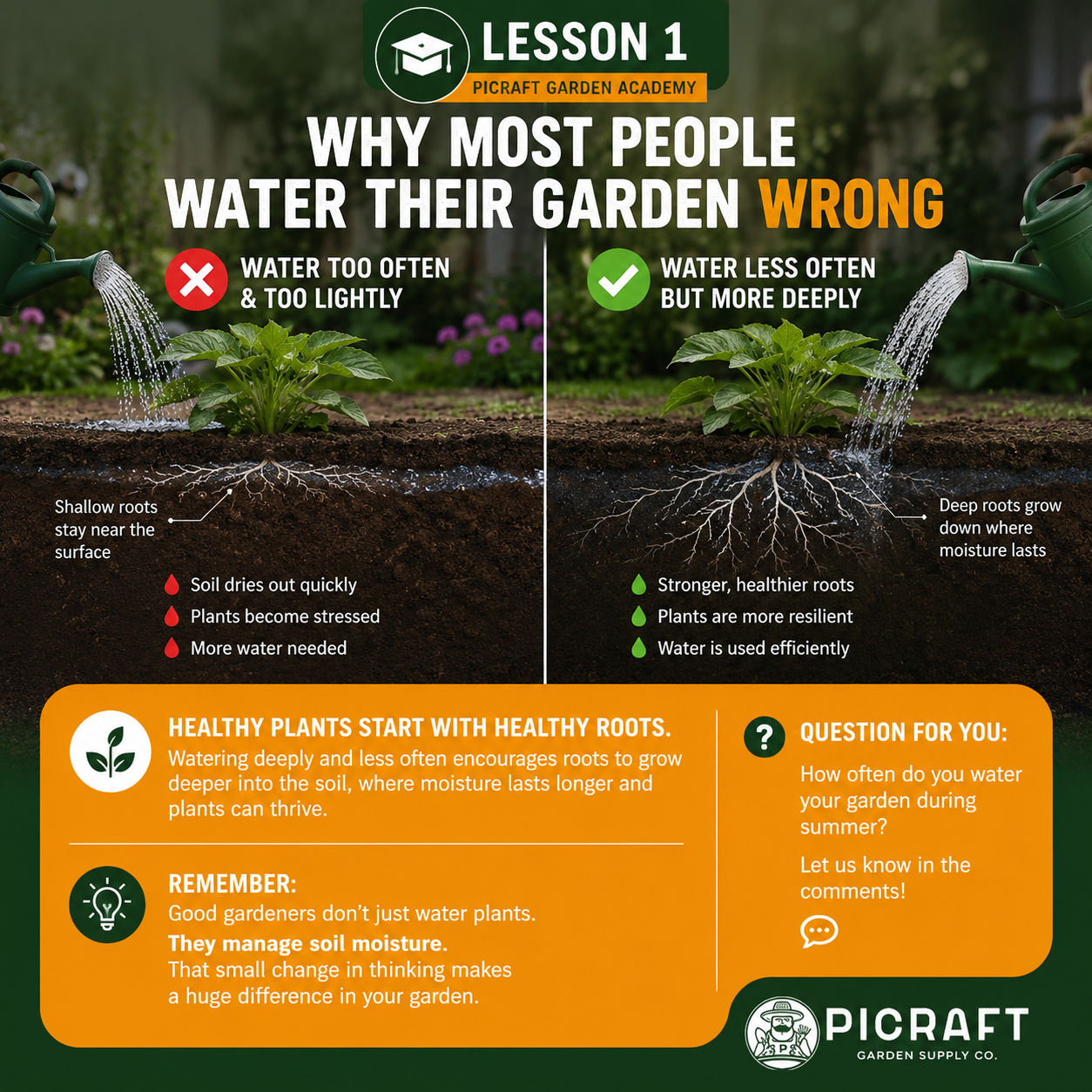
The Hidden Watering Mistake That Prevents Plants from Thriving
Many gardeners believe that if plants look tired, dry or wilted, the answer is simple: add more water.
Surprisingly, this is often the wrong solution.
One of the biggest mistakes home gardeners make isn't underwatering—it's watering incorrectly. The way you water your garden has a huge impact on root development, plant health, water consumption and even how often you need to water in the future.
In this guide, we'll explain why watering technique matters more than watering quantity, and how a few simple changes can help you grow healthier plants while using less water.
Why Watering More Doesn't Always Help
It's easy to assume that more water means healthier plants.
In reality, plants don't benefit from excess water—they benefit from consistent soil moisture.
When water is applied too frequently or only to the surface, it creates an environment where roots never need to grow deeper. As a result, plants become dependent on frequent watering and are far more vulnerable during hot weather.
Healthy gardens are not created by using more water.
They are created by using water more effectively.
The Most Common Watering Mistake
Many gardeners water a little every day.
Although this keeps the surface of the soil looking damp, it rarely delivers enough moisture to the deeper root zone.
This encourages shallow root growth, which creates several problems:
- Plants dry out quickly during warm weather.
- Roots remain close to the soil surface.
- Water evaporates before plants can fully benefit.
- Plants become more sensitive to drought.
- More frequent watering is required.
Over time, this cycle wastes water while producing weaker plants.
Healthy Roots Create Healthy Plants
Professional gardeners focus on roots rather than leaves.
Roots naturally grow towards moisture. When water reaches deeper into the soil, the root system follows it, creating stronger and more resilient plants.
Deep-rooted plants benefit from:
- Better drought tolerance
- Improved nutrient uptake
- Stronger overall growth
- Better flowering and fruit production
- Reduced watering frequency
Instead of encouraging plants to rely on daily watering, deep irrigation teaches them to become more self-sufficient.
Water the Soil, Not the Leaves
One of the biggest misconceptions in gardening is that plants absorb water through their leaves.
In reality, almost all water is absorbed through the roots.
That means the goal of irrigation isn't simply to wet the plant—it's to deliver water directly into the soil where roots can access it.
Whether you're using a watering can, garden hose or a drip irrigation system, watering the root zone is always more effective than spraying foliage.
Deep Watering vs Frequent Watering
Imagine two identical plants.
Plant A
- Receives a light watering every evening.
- Develops shallow roots.
- Needs constant attention.
Plant B
- Receives a deep watering every few days.
- Develops deep roots.
- Remains healthier during dry weather.
Although Plant A receives water more often, Plant B usually becomes stronger because its roots have learned to search deeper into the soil for moisture.
Why Drip Irrigation Makes Watering Easier
One of the easiest ways to water correctly is by using a drip irrigation system.
Unlike traditional watering methods, drip irrigation delivers water slowly and precisely to the root zone.
Benefits include:
- Lower water consumption
- Healthier root systems
- Less evaporation
- Reduced weed growth
- More consistent soil moisture
- Easy automation with garden tap timers
For most home gardens, a 16mm LDPE mainline irrigation pipe forms the foundation of an efficient watering system, allowing you to add drippers, spray misters and micro sprinklers exactly where they're needed.
Signs You're Watering Incorrectly
Your watering routine may need adjusting if you notice:
- Plants wilt shortly after watering
- Soil is only wet on the surface
- Roots stay close to the top of the soil
- Water runs off before soaking in
- You need to water every day during summer
These are all signs that your garden may benefit from deeper, more targeted watering.
Key Takeaways
Successful irrigation isn't about using more water—it's about applying the right amount of water, in the right place, at the right time.
Remember these simple principles:
- Water deeply rather than frequently.
- Focus on the root zone, not the leaves.
- Encourage deep root growth.
- Maintain consistent soil moisture.
- Consider drip irrigation for greater efficiency.
Small improvements in your watering habits can make a significant difference to plant health while helping you save both water and time.
Frequently Asked Questions
Is it better to water every day?
Not usually. Most gardens benefit from deeper, less frequent watering that encourages stronger root growth.
Why do my plants still wilt after watering?
Shallow watering often fails to reach the deeper root zone. While the surface appears wet, roots may still lack sufficient moisture.
Does drip irrigation save water?
Yes. Drip irrigation delivers water directly where plants need it, reducing evaporation and unnecessary runoff.
Should I water leaves or soil?
Always aim to water the soil around the root zone rather than the leaves.
Can beginners install a drip irrigation system?
Absolutely. Most modern garden irrigation systems are designed for DIY installation and can easily be expanded as your garden grows.
Continue Learning with Picraft Garden Academy
This article is part of the Picraft Garden Academy—our educational series designed to help gardeners build healthier gardens through smarter watering and practical irrigation advice.