
The Complete UK Guide to Healthier Roots, Smarter Watering and Better Garden Irrigation
Picraft Garden Academy | Smart Irrigation, Soil Health & Practical Gardening
What if the secret to a healthier garden wasn't watering more often — but understanding when, where and how much water your plants actually need?
Many gardeners believe successful irrigation is simply about keeping the soil wet.
Others assume that installing an automatic watering system will solve every problem.
But neither approach tells the whole story.
Healthy plants need the right balance of water, oxygen, nutrients and suitable growing conditions.
Too little water can restrict growth and cause stress.
Too much water can reduce oxygen around the roots, contribute to waterlogging and create conditions that favour certain plant diseases.
And even a sophisticated irrigation system can waste water if it operates at the wrong time or delivers water to the wrong place.
Smart irrigation isn't about using the most advanced equipment. It's about making better watering decisions.
Whether you use a watering can, garden hose, drip irrigation system or automatic timer, the same fundamental principles apply.
In this Picraft Garden Academy guide, we'll explore ten practical principles that can help UK gardeners use water more efficiently, protect root health and prepare their gardens for changing weather conditions.
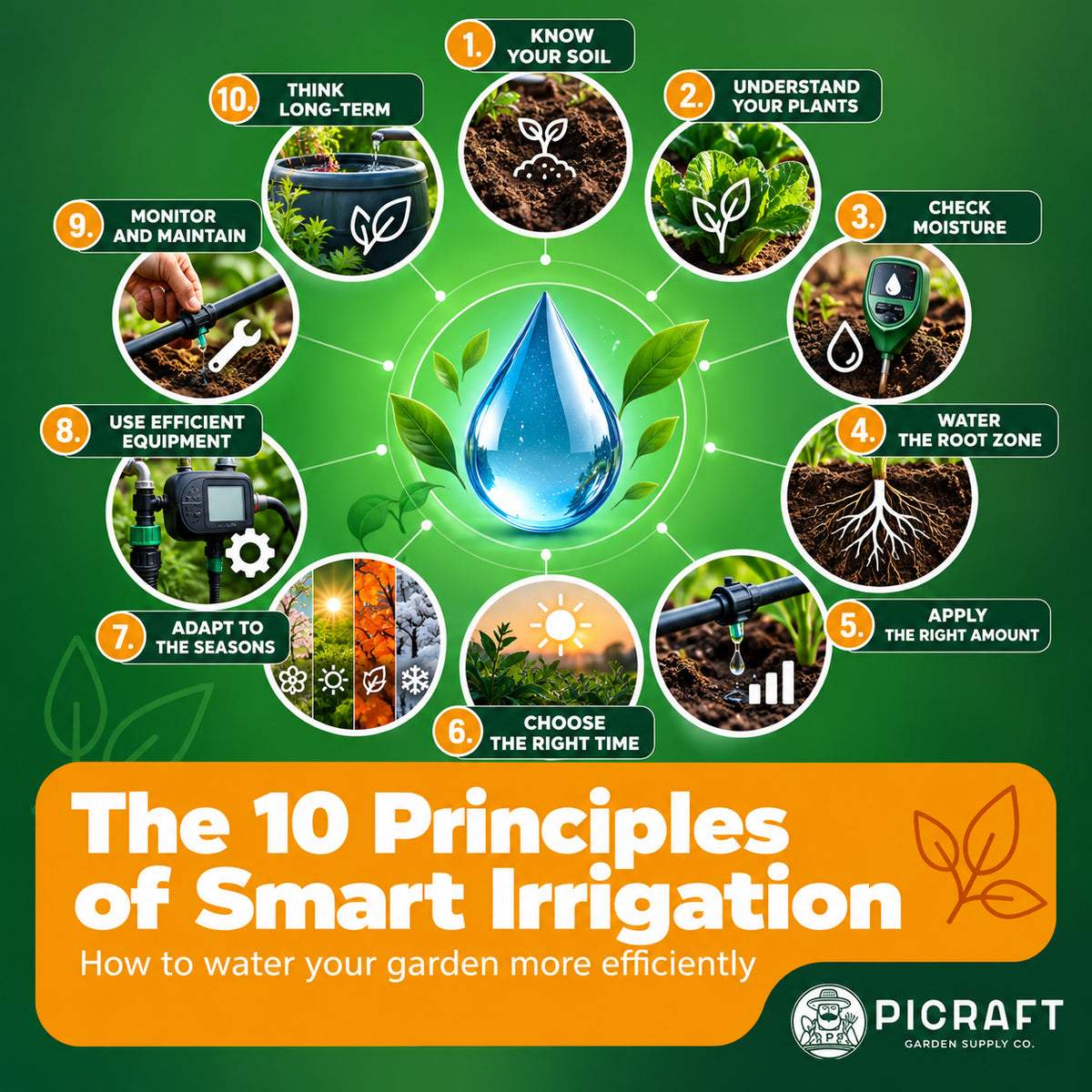
Quick Answer: What Are the 10 Principles of Smart Irrigation?
Smart irrigation follows ten essential principles:
-
Know Your Soil — Understand how your soil absorbs, holds and drains water.
-
Understand Your Plants — Match watering to plant species, size and root development.
-
Check Moisture Before Watering — Never rely on a fixed schedule alone.
-
Water the Root Zone — Deliver moisture where plants can use it.
-
Apply the Right Amount — Avoid both shallow watering and excessive saturation.
-
Choose the Right Time — Reduce avoidable evaporation and consider weather conditions.
-
Adapt to the Seasons — Change your approach as temperatures and plant growth change.
-
Use Efficient Equipment — Choose appropriate watering tools and irrigation systems.
-
Monitor and Maintain — Check for leaks, blockages and uneven watering.
-
Think Long-Term — Improve soil health, plant selection and water management.
The central idea is simple:
Give plants the water they need — no more, no less — while protecting the health of the soil around their roots.
Principle 1: Know Your Soil Before You Water
Every smart irrigation decision begins beneath the surface.
Soil is not simply something that holds plants upright.
It's a complex environment containing mineral particles, organic matter, water, air and living organisms.
The spaces between soil particles determine how water moves, how much moisture is retained and how easily oxygen reaches the roots.
Sandy Soil
Sandy soils generally have larger particles and drain relatively quickly.
They may need more frequent moisture checks during dry weather, particularly around young plants.
Clay Soil
Clay-rich soils can hold substantial amounts of water.
However, they may drain slowly, especially when compacted.
Applying additional water while clay soil is already saturated can make root conditions worse.
Loamy Soil
Well-structured loam often offers a useful balance between moisture retention and drainage.
But even loamy soil can suffer from compaction and waterlogging.
Why This Matters
Imagine two gardens receiving exactly the same amount of water.
One has free-draining sandy soil.
The other has heavy clay.
The water may move through these soils very differently.
A watering schedule suitable for one garden may be completely inappropriate for the other.
Smart Irrigation Action
Before planning a watering routine, identify your soil type and observe how it behaves after rainfall.
Picraft Garden Tip: The smarter you understand your soil, the less guesswork you need when watering.
Principle 2: Understand What Your Plants Actually Need
Not all plants need the same amount of water.
Their requirements depend on factors such as:
-
Plant species.
-
Root depth and development.
-
Growth stage.
-
Container size.
-
Exposure to sun and wind.
-
Soil conditions.
-
Time of year.
Newly Planted vs Established Plants
Newly planted shrubs and trees often have relatively limited root systems.
They may require more careful moisture monitoring while becoming established.
Established plants may be able to access water from a larger volume of soil.
Containers vs Garden Beds
A container holds a limited amount of compost.
It can dry out faster than surrounding garden soil, particularly in warm or windy conditions.
Vegetables vs Ornamental Plants
Some vegetables require relatively consistent moisture during active growth.
Other plants tolerate drier conditions.
Smart Irrigation Action
Group plants with similar watering requirements.
If you're using automatic irrigation, consider separate watering zones where appropriate.
The goal is not to give every plant equal amounts of water. It's to meet each plant's actual needs.
Principle 3: Check Soil Moisture Before Watering
One of the most common gardening mistakes is watering simply because it's a particular day.
Monday means watering.
Thursday means watering.
The timer runs every morning.
But plants don't follow a calendar.
Their water requirements change with rainfall, temperature, wind, growth and soil conditions.
Why Fixed Schedules Can Fail
A watering routine that works during a hot July may apply far too much water in a cool, wet November.
Even during summer, a week of heavy rain can dramatically change soil moisture.
How to Check Moisture
For many garden plants, you can begin with a simple inspection.
-
Choose a location near the root zone.
-
Check moisture beneath the surface.
-
Consider how deeply the roots extend.
-
Observe the plant's condition.
-
Water only if additional moisture is needed.
What About Soil Moisture Sensors?
Sensors can provide useful information, particularly in automated systems.
However, their accuracy and usefulness depend on correct placement, calibration where required and interpretation.
A sensor positioned in an unusually wet or dry area may not represent the whole planting bed.
Smart Irrigation Action
Make moisture checking part of your normal gardening routine.
Don't ask, "Is it time to water?" Ask, "Does the soil actually need water?"
Principle 4: Water the Root Zone, Not Everything Around It
Plants absorb most of their water through their roots.
This means irrigation should focus on making moisture available within the active root zone.
Watering paths, fences and unused ground provides little benefit.
Why Targeted Watering Matters
Applying water near the root zone can reduce unnecessary losses.
It can also help avoid wetting foliage where this offers no benefit.
However, watering should reach a suitable area of the root system rather than being concentrated permanently at one tiny point.
Manual Watering
Use a watering can or suitable hose attachment to apply water gently around the plant's rooting area.
Drip Irrigation
Drip emitters can deliver water slowly near plant roots.
Their spacing and flow should suit the plant, soil and installation.
Sprinkler Irrigation
Sprinklers can be appropriate for lawns and larger areas.
However, they should be positioned to minimise overspray onto paths and other surfaces.
Smart Irrigation Action
Observe where your water lands.
If substantial amounts are reaching places where no plants need it, adjust your watering method.
Smart irrigation delivers water where it provides the greatest benefit.
Principle 5: Apply the Right Amount of Water
Watering too little and watering too much can both create problems.
The objective is to moisten the relevant root zone without causing prolonged saturation or excessive drainage.
The Problem with Very Shallow Watering
Small, frequent applications may wet only the uppermost layer of soil.
Depending on the plant and conditions, deeper roots may receive insufficient moisture.
The Problem with Excessive Watering
Applying more water than the soil can absorb or retain may cause:
-
Surface runoff.
-
Waterlogging.
-
Reduced oxygen availability.
-
Nutrient leaching.
-
Unnecessary water consumption.
Is Deep Watering Always Better?
Not necessarily.
Deeper, less frequent watering is often useful for established plants in suitable soil.
However, young seedlings, shallow-rooted plants and container-grown crops may require a different approach.
The correct amount depends on the plant and its root zone.
Smart Irrigation Action
Apply water at a rate the soil can absorb.
After watering, check whether moisture has reached the intended depth.
Effective irrigation is measured by soil moisture and plant response — not simply by how long the hose was running.
Principle 6: Choose the Right Time to Water
Watering time can affect efficiency and plant conditions.
During warm weather, applying water when evaporation demand is lower can reduce unnecessary losses.
Early Morning Watering
Early morning is often a practical choice during the growing season.
Temperatures are generally cooler, winds may be lighter and plants have moisture available as the day warms.
Midday Watering
During hot, sunny weather, evaporation and wind losses may be greater.
However, plants experiencing genuine water stress should not be left without necessary water simply because it is midday.
Evening Watering
Evening watering can reduce some evaporation losses.
However, prolonged leaf wetness overnight may favour certain diseases in susceptible plants.
Winter Watering
During winter, the main consideration is often whether watering is necessary at all.
Avoid watering frozen ground or creating icy surfaces.
If plants genuinely need moisture, choose suitable conditions when the soil is unfrozen.
Smart Irrigation Action
Consider weather, soil moisture and plant requirements before deciding when to water.
The best watering time is one that supports plant health while avoiding unnecessary water loss.
Principle 7: Adapt Your Irrigation to the Seasons
A garden's water requirements change throughout the year.
Yet many watering problems occur because gardeners continue using the same routine regardless of the season.
Spring: Monitor New Growth
As temperatures rise and plants begin growing, their water demand may increase.
Newly planted trees, shrubs and young vegetables often need closer attention.
Summer: Respond to Heat and Dry Conditions
During hot weather, evaporation and plant water use can increase significantly.
Containers and actively growing vegetables may need frequent moisture checks.
Autumn: Reduce Unnecessary Watering
As temperatures fall and growth slows, many plants require less supplementary water.
Rainfall may keep soil moist for longer.
Winter: Protect Roots and Equipment
During a typical wet British winter, established outdoor plants often need little additional watering.
However, sheltered containers, newly planted shrubs and some evergreens may still require attention during dry periods.
Irrigation equipment may also need draining and frost protection.
Why November Matters
November is an excellent time to review your garden's watering performance.
Observe which areas become waterlogged.
Identify sheltered containers that remain dry.
Check whether your irrigation layout worked effectively during summer.
Then use what you've learned to plan improvements for spring.
Smart Irrigation Action
Review your watering approach whenever the season changes.
A smart irrigation system should adapt to the garden — not force the garden to follow an unchanged schedule.
Principle 8: Use the Right Irrigation Equipment
Good equipment can make watering easier and more consistent.
But more expensive equipment doesn't automatically mean better results.
The best choice depends on your garden.
Watering Cans
Useful for small gardens, individual containers and precise watering.
Garden Hoses
Flexible and practical for larger areas or occasional watering.
Choose suitable spray attachments and avoid unnecessarily powerful jets.
Drip Irrigation
Can provide targeted water delivery to vegetable beds, borders and containers.
Correct emitter spacing, flow and pressure are important.
Soaker Hoses
Can distribute water along planted rows or beds.
Performance depends on the hose and installation conditions.
Sprinklers
Useful for wider coverage, particularly lawns.
Correct positioning helps reduce overspray.
Automatic Timers
Provide convenient scheduling.
However, a basic timer follows instructions rather than measuring whether plants need water.
Smart Controllers and Sensors
Some systems can respond to soil moisture or weather information.
These features can help reduce unnecessary irrigation when configured correctly.
Smart Irrigation Action
Choose equipment based on the watering problem you're trying to solve.
Start with the plants and soil. Choose the technology afterwards.
Principle 9: Monitor, Maintain and Adjust Your System
Even a well-designed irrigation system needs attention.
Equipment can become blocked, damaged or incorrectly adjusted.
Watering requirements also change as plants grow.
Common Problems to Watch For
Leaks
Damaged hoses and loose fittings can waste water.
Blocked Drippers
Sediment and debris can reduce or stop water delivery.
Uneven Sprinkler Coverage
Some areas may receive too much water while others remain dry.
Incorrect Timer Settings
A summer schedule may continue unnecessarily into autumn.
Pressure Problems
Insufficient or excessive pressure can affect system performance.
Winter Damage
Freezing water can damage vulnerable hoses, valves and connectors.
A Simple Maintenance Routine
-
Inspect hoses and connections.
-
Check emitters and sprinklers.
-
Look for leaks.
-
Observe soil moisture in different locations.
-
Review watering schedules.
-
Clean filters where required.
-
Prepare vulnerable equipment for frost.
Smart Irrigation Action
Don't assume that because water is flowing, the system is working correctly.
Smart irrigation requires feedback, inspection and occasional adjustment.
Principle 10: Think Beyond Watering — Build a Garden That Uses Water Better
The smartest irrigation strategy isn't always about improving the watering system.
Sometimes, the biggest improvements come from changing the garden itself.
Improve Soil Structure
Healthy, well-structured soil can support both moisture retention and drainage.
Suitable organic matter and careful soil management may improve conditions over time.
Use Mulch Appropriately
Organic mulch can help reduce evaporation and moderate soil temperature.
Keep mulch away from direct contact with vulnerable stems and trunks where appropriate.
Choose Suitable Plants
Plants adapted to your soil and growing conditions may require less intervention once established.
Reduce Soil Compaction
Compacted soil can restrict water movement and root growth.
Avoid unnecessary traffic over wet beds.
Collect Rainwater
Water butts can provide a useful supplementary water source.
Check whether the storage and delivery arrangement is suitable for your intended irrigation equipment.
Design Better Planting Areas
Group plants with similar needs.
Consider sun exposure, drainage and access to water.
Smart Irrigation Action
Look for ways to reduce unnecessary watering demand before investing in more complex equipment.
The most efficient garden is not necessarily the one with the most advanced irrigation system — it's the one designed to use water wisely.
The 10 Principles of Smart Irrigation at a Glance
| Principle | Key question |
|---|---|
| 1. Know Your Soil | How does my soil hold and drain water? |
| 2. Understand Your Plants | What does each plant actually need? |
| 3. Check Moisture | Is additional water necessary? |
| 4. Target the Root Zone | Is water reaching the right place? |
| 5. Apply the Right Amount | Am I watering enough without overdoing it? |
| 6. Choose the Right Time | When will watering be most useful? |
| 7. Adapt to the Seasons | Have conditions changed? |
| 8. Use Efficient Equipment | Am I using the right method? |
| 9. Monitor and Maintain | Is my system working correctly? |
| 10. Think Long-Term | Can I make my garden less dependent on watering? |
How to Apply All 10 Principles in a Typical UK Garden
Imagine a garden containing:
-
A small lawn.
-
Two raised vegetable beds.
-
Several established shrubs.
-
Newly planted evergreen plants.
-
Patio containers.
A smart watering strategy might look like this:
Lawn
Monitor soil moisture and seasonal conditions.
Avoid unnecessary irrigation during wet weather.
Vegetable Beds
Consider drip irrigation for targeted delivery.
Adjust watering according to crop growth and soil moisture.
Established Shrubs
Water when needed rather than following a frequent fixed schedule.
Newly Planted Evergreens
Check the root zone during dry periods, including in winter when conditions permit.
Patio Containers
Inspect compost regularly, especially beneath shelter.
Automatic Equipment
Use suitable timers or controllers, review settings and inspect the system for leaks.
Winter Preparation
Reduce unnecessary watering and protect vulnerable components before frost.
The result is not one watering schedule for the entire garden.
It's a coordinated approach based on different plant needs and conditions.
Common Smart Irrigation Myths
Myth 1: Automatic Irrigation Always Saves Water
Reality: It can improve efficiency, but poorly configured systems can waste water.
Myth 2: Plants Need Water Every Day
Reality: Watering frequency depends on species, soil, weather and growing conditions.
Myth 3: Wet Soil Means Healthy Plants
Reality: Prolonged saturation can reduce oxygen around roots.
Myth 4: More Water Produces Faster Growth
Reality: Excessive watering can interfere with healthy root function.
Myth 5: Rain Means Every Plant Has Enough Water
Reality: Sheltered containers and newly planted root balls can remain dry.
Myth 6: A Smart Controller Removes the Need for Garden Checks
Reality: Sensors and controllers still require appropriate setup, inspection and maintenance.
Myth 7: Irrigation Is Only Important in Summer
Reality: Planning, drainage management and equipment maintenance matter throughout the year, even when watering itself is unnecessary.
Smart Irrigation Checklist for UK Gardeners
Use this checklist when reviewing your watering habits.
Before Watering
☐ Check soil moisture.
☐ Consider recent rainfall.
☐ Assess the plant's requirements.
☐ Check whether the soil is already saturated.
☐ Choose a suitable watering method.
During Watering
☐ Direct water towards the root zone.
☐ Apply water at a suitable rate.
☐ Avoid unnecessary runoff.
☐ Check that all intended plants receive water.
After Watering
☐ Assess moisture penetration.
☐ Look for pooling or drainage problems.
☐ Inspect equipment for leaks.
☐ Adjust future watering if needed.
Seasonal Checks
☐ Review irrigation settings in spring.
☐ Monitor moisture more closely during hot weather.
☐ Reduce unnecessary watering in autumn.
☐ Winterise vulnerable equipment before frost.
Frequently Asked Questions
What is smart irrigation?
Smart irrigation means applying water according to actual plant needs, soil conditions and weather. It may involve manual observation, sensors, automated controls or a combination of methods.
Do I need an automatic system for smart irrigation?
No. You can follow smart irrigation principles using a watering can or hose.
Does smart irrigation save water?
It can help reduce unnecessary watering, runoff and other losses when applied correctly. Actual savings depend on the garden and irrigation method.
How do I know when my garden needs water?
Check moisture within the relevant root zone and consider plant type, recent rainfall and weather conditions.
Is drip irrigation the best watering method?
Drip irrigation can be highly suitable for many planted beds and containers, but sprinklers or manual watering may be more practical in other situations.
Can smart irrigation prevent overwatering?
Appropriate moisture monitoring and irrigation control can reduce the risk, but no system eliminates the need for correct setup and maintenance.
Should I water my garden every day in summer?
Not necessarily. Some containers and crops may require frequent watering, while established plants in suitable soil may need less frequent applications.
Should I water plants during winter in the UK?
Many established plants need little supplementary watering during a typical wet winter. However, sheltered containers, new plantings and some evergreens may need water during dry periods when conditions are suitable.
What is the best time of day to water?
Early morning is often a practical choice during warm weather. However, water genuinely stressed plants when necessary rather than waiting rigidly for a particular time.
Are soil moisture sensors accurate?
They can be useful, but performance depends on the device, placement, growing medium and correct interpretation.
Can I use rainwater for irrigation?
Yes, provided the water supply, storage and delivery equipment are suitable for the intended use.
Is smart irrigation expensive?
Not necessarily. Many smart watering habits require no additional equipment. More advanced automated systems involve higher initial costs.
What is the most important principle of smart irrigation?
Understanding whether the root zone actually needs water before applying more.
Final Thoughts: Smart Irrigation Starts with Better Decisions
Smart irrigation isn't about watering every day.
It isn't about installing the most expensive controller.
And it isn't about following one perfect schedule throughout the year.
It's about understanding the relationship between plants, soil, water and weather.
The ten principles work together.
Knowing your soil helps you understand how water behaves.
Understanding your plants helps you decide how much moisture they need.
Checking the root zone prevents unnecessary watering.
Choosing suitable equipment makes the process easier.
And adjusting your approach throughout the seasons helps your garden respond to changing conditions.
For UK gardeners, this flexibility is particularly important.
Our weather can change quickly, and rainfall doesn't always arrive when or where plants need it.
The smartest gardener isn't the one who waters most often — it's the one who knows when watering is genuinely necessary.
As autumn turns into winter, take the opportunity to observe your garden, inspect your equipment and plan improvements for the next growing season.
Your plants — and your water supply — may benefit from it.
Continue Learning with Picraft Garden Academy
Explore our related guides:
-
Manual Watering vs Automatic Irrigation: Which Is Better for Your Garden?
-
7 Autumn & Winter Watering Mistakes That Could Be Damaging Your Garden
-
Autumn Garden Watering: When, How Often and Do You Still Need to Water?
-
Does the UK Really Get Enough Rain for Your Garden? A Season-by-Season Guide
-
Why Consistency Beats Quantity When Watering Your Garden
-
Why Soil Type Changes Everything
Explore garden watering equipment, irrigation accessories and practical outdoor supplies at Picraft Garden Supply Co..
📚 Picraft Garden Academy
Practical gardening knowledge, one lesson at a time.