
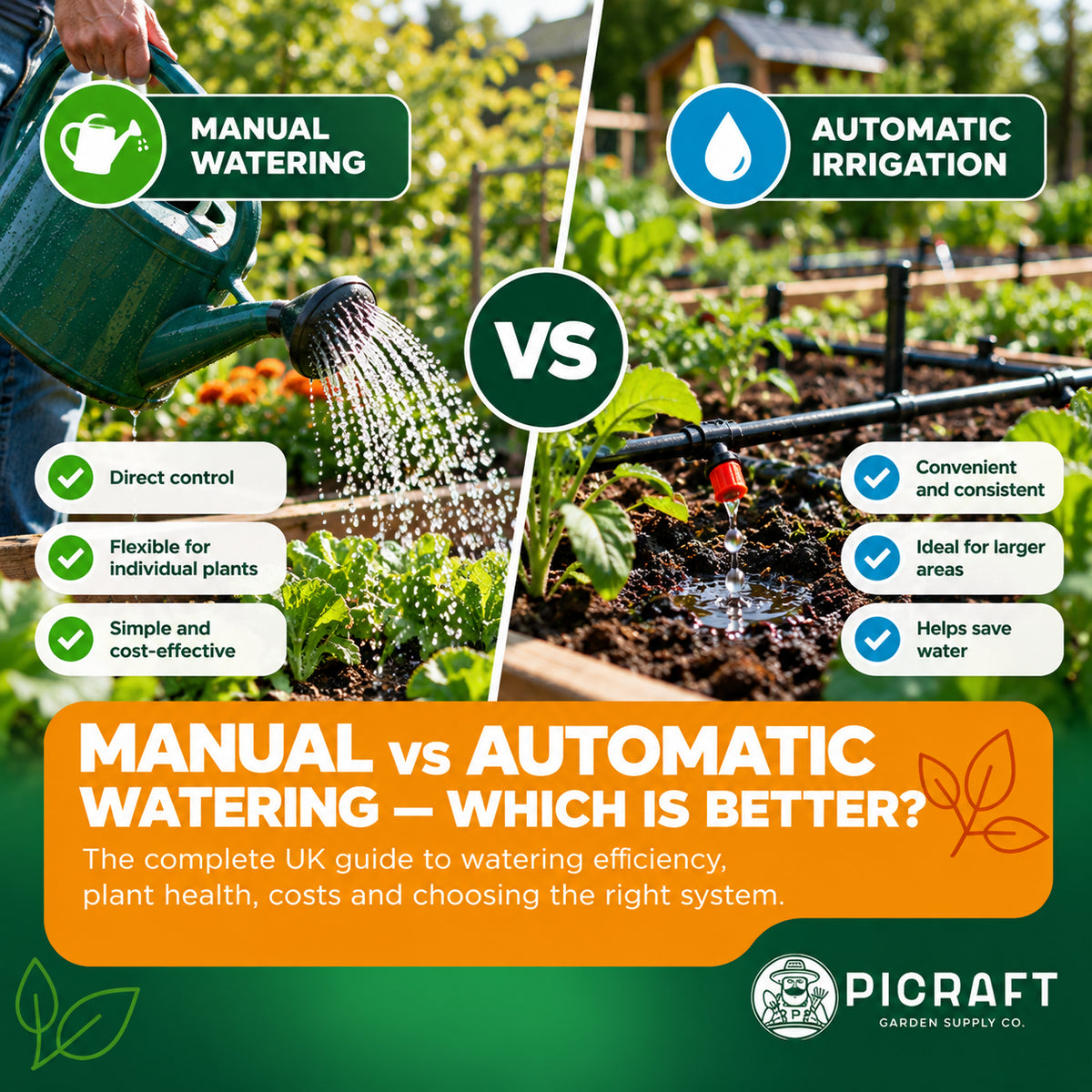
The Complete UK Guide to Watering Efficiency, Plant Health, Costs and Choosing the Right System
Picraft Garden Academy | Smart Irrigation & Practical Gardening
Every garden needs water.
But how that water reaches your plants can make a significant difference to their health, your gardening routine and your household water consumption.
For generations, gardeners have relied on watering cans and hoses.
Today, automatic irrigation systems offer another approach — delivering water through sprinklers, drip lines and timers, sometimes without the gardener needing to be present.
But does automatic irrigation actually produce healthier plants?
Does it save water?
And is it worth investing in for a typical British garden, where rainfall can be frequent and unpredictable?
The answer isn't as straightforward as you might think.
Automatic irrigation isn't automatically better than manual watering. And manual watering isn't necessarily less efficient.
Both methods can work extremely well when used correctly.
Both can also waste water or damage plants when used without understanding soil moisture, root development and changing weather conditions.
In this Picraft Garden Academy guide, we'll compare manual watering and automatic irrigation, explore their advantages and disadvantages, explain the costs involved and help you decide which approach makes the most sense for your garden.
Quick Answer: Is Manual Watering or Automatic Irrigation Better?
Manual watering is often the simplest and most cost-effective choice for small gardens, occasional watering and individual containers. Automatic irrigation can be more convenient for larger gardens, vegetable beds, greenhouses and gardeners who need consistent watering while away from home.
However, neither method guarantees healthier plants or lower water consumption.
The results depend on:
-
How much water is applied.
-
Where the water is delivered.
-
How often watering takes place.
-
Soil type and drainage.
-
Plant species and root development.
-
Weather conditions.
-
Whether watering is adjusted to actual soil moisture.
A well-managed watering can may be more efficient than a poorly configured sprinkler system.
Equally, a correctly designed drip irrigation system can deliver water more precisely and consistently than hurried manual watering.
The best irrigation system is the one that delivers the right amount of water, to the right place, at the right time.
1. What Is Manual Watering?
Manual watering means applying water directly to plants using equipment controlled by the gardener.
Common methods include:
-
Watering cans.
-
Garden hoses.
-
Hose spray guns.
-
Hand-held watering wands.
-
Buckets or other suitable containers.
The gardener decides when to water, where to apply it and how much each plant receives.
How Manual Watering Works
Imagine you have a small patio garden with six containers.
You inspect the compost in each pot.
Two are still moist.
Three are becoming dry.
One contains a plant that prefers relatively dry conditions.
With a watering can, you can respond to each plant individually.
You water only the pots that need it.
This flexibility is one of manual watering's greatest strengths.
Advantages of Manual Watering
Low initial cost
A watering can or basic hose is generally inexpensive compared with installing a complete irrigation system.
Direct control
You can adjust the amount of water for individual plants.
Easy to change
No programming or complex equipment is needed when your garden layout changes.
Encourages observation
Regularly inspecting plants can help you notice pests, diseases, dry compost and drainage problems.
Ideal for smaller spaces
A few containers or a compact flower bed may not justify automatic equipment.
Disadvantages of Manual Watering
Time-consuming
Watering a large garden can take considerable time.
Inconsistent application
Different people may apply different quantities of water.
Easy to forget
Busy schedules, holidays and unexpected commitments can interrupt watering.
Uneven distribution
Some plants may receive too much water while others receive too little.
Potential water waste
Leaving a hose running or applying water too quickly can cause runoff.
Picraft Garden Tip
Manual watering is most effective when you treat it as an opportunity to inspect your plants — not simply another chore to complete as quickly as possible.
2. What Is Automatic Irrigation?
Automatic irrigation is a system that delivers water according to a programmed schedule or a control signal.
Depending on the design, it may include:
-
Drip irrigation tubing.
-
Drippers or emitters.
-
Soaker hoses.
-
Sprinklers.
-
Micro-sprayers.
-
Watering timers.
-
Valves.
-
Filters.
-
Pressure regulators.
-
Soil moisture sensors.
-
Weather-responsive controllers.
The simplest system might involve a hose-connected timer supplying a small drip line.
A more sophisticated installation could contain several irrigation zones, each controlled independently.
How Automatic Irrigation Works
Imagine you have a vegetable garden with four raised beds.
Each bed contains drip irrigation tubing.
A timer controls when water is supplied.
Instead of manually carrying water to every bed, the system distributes it through emitters positioned near the plants.
The watering duration can be adjusted according to the season and plant requirements.
Some controllers can also use moisture or weather information to reduce unnecessary watering.
However, it's important to understand one thing.
A basic timer doesn't know whether your garden needs water.
It simply follows its programmed schedule.
This distinction becomes particularly important in the UK, where rainfall can change significantly from one week to the next.
3. Manual Watering vs Automatic Irrigation: The Main Differences
| Feature | Manual Watering | Automatic Irrigation |
|---|---|---|
| Initial cost | Usually low | Usually higher |
| Installation | Minimal | Basic to complex |
| Daily effort | Requires your time | Can operate with little daily involvement |
| Watering consistency | Depends on the gardener | Generally consistent when correctly configured |
| Individual plant control | Very flexible | Depends on system design and zones |
| Water efficiency | Can be excellent | Can be excellent |
| Holiday watering | Requires help or preparation | Can operate while you're away |
| Maintenance | Usually simple | Requires inspection and upkeep |
| Seasonal adjustment | Decided during each watering | Schedule or controls must be adjusted |
| Frost preparation | Drain and store equipment as appropriate | May require more extensive winterisation |
| Best suited to | Small gardens and varied containers | Larger areas and repeated watering needs |
Which Method Uses Less Water?
There is no universal winner.
A gardener using a watering can carefully may use less water than a sprinkler system operating unnecessarily during rainfall.
On the other hand, a properly designed drip system can reduce losses from overspray, runoff and watering areas where plants are not growing.
Efficiency depends more on how water is applied than whether the process is manual or automatic.
4. Water Efficiency: Which System Wastes Less?
Water efficiency is one of the most important considerations when choosing an irrigation method.
But first, we need to understand what water waste actually means.
Water may be wasted when:
-
It runs off the soil before soaking in.
-
It lands on paths or patios.
-
It drains beyond the active root zone.
-
It evaporates unnecessarily from exposed surfaces.
-
Plants receive more water than they need.
-
Irrigation operates despite sufficient rainfall.
Manual Watering and Efficiency
Manual watering can be highly efficient when you apply water slowly around the root zone.
A watering can with a suitable rose or a hose with adjustable flow allows you to control application.
However, watering quickly with a powerful hose jet can cause runoff or disturb the soil.
Automatic Irrigation and Efficiency
Automatic systems can be efficient because water delivery can be planned and repeated consistently.
Drip irrigation, in particular, can target the soil near plant roots.
But poorly adjusted sprinklers may water fences, paths and empty spaces.
And an automatic system operating during a wet week can waste considerable water.
The Importance of Soil Moisture
The real question isn't:
"How long should I water?"
It's:
"How much water does the soil actually need?"
A system that responds to soil conditions is often more useful than one that follows the same routine regardless of weather.
Picraft Garden Tip
A timer improves convenience. A properly used moisture sensor or weather-responsive controller can help improve watering decisions.
They are not the same thing.
5. Which Method Is Better for Plant Health?
Healthy plants depend on more than regular watering.
Their roots need access to both water and oxygen.
The goal is to maintain suitable moisture conditions without keeping the root zone continuously saturated.
Manual Watering: The Plant-by-Plant Approach
Manual watering allows you to respond to individual plants.
For example:
A newly planted shrub may require closer monitoring than an established one.
A container in direct sunlight may dry out faster than a pot beneath a covered patio.
A drought-tolerant plant may need less frequent watering than a moisture-loving species.
Manual watering makes these differences easy to accommodate.
Automatic Irrigation: Consistency Across Larger Areas
Automatic irrigation can be useful where many plants have similar watering requirements.
Vegetable beds, greenhouse crops and groups of containers may benefit from controlled, repeated water delivery.
However, grouping plants with very different requirements onto one irrigation schedule can create problems.
Why Watering Zones Matter
An irrigation zone is an area or group of plants supplied under the same control.
For example:
Zone 1: Vegetable beds.
Zone 2: Greenhouse containers.
Zone 3: Established shrubs.
These areas may need different watering durations or frequencies.
A well-designed system recognises those differences.
Which Is Better for Roots?
Neither method is inherently better.
Root health depends on suitable moisture, drainage, oxygen availability and plant-specific needs.
Consistent watering is useful only when the amount and timing are appropriate.
6. The Real Cost of Manual Watering vs Automatic Irrigation
Many gardeners focus on the purchase price of irrigation equipment.
But the real cost includes more than installation.
You should also consider:
-
Water consumption.
-
Time spent watering.
-
Maintenance.
-
Replacement components.
-
Seasonal adjustments.
-
Repairs.
-
Equipment lifespan.
Manual Watering Costs
Manual watering equipment is generally affordable.
You may only need a watering can, hose and spray attachment.
The main ongoing costs are water consumption and your time.
For a small garden, this may be the most economical option.
Automatic Irrigation Costs
An automatic system may require:
-
Tubing or hose.
-
Connectors and fittings.
-
Emitters or sprinklers.
-
A timer or controller.
-
Filters and pressure regulation where required.
-
Suitable installation materials.
More complex systems may require professional design or installation.
Does Automatic Irrigation Pay for Itself?
Sometimes, but not necessarily through water savings alone.
The value may come from:
-
Reduced time spent watering.
-
More consistent care during holidays.
-
Better management of large planting areas.
-
Reduced risk of missed watering.
-
Easier management of repeated tasks.
However, savings depend on the system and how it is operated.
An automatic irrigation system should not be assumed to reduce water bills without evidence.
A Simple Cost Comparison
Imagine two gardeners.
Gardener A has ten containers on a patio.
Watering takes five minutes.
An automatic system may offer convenience, but the financial benefit could be limited.
Gardener B manages multiple raised beds, greenhouse crops and a large planted area.
Manual watering takes substantially longer.
For this gardener, automatic irrigation may offer significant time savings.
The right choice depends on scale and personal priorities.
7. Is Automatic Irrigation Worth It for Small UK Gardens?
Not every garden needs automation.
For a compact garden, manual watering may be perfectly adequate.
But automatic irrigation can still be useful in small spaces under certain circumstances.
When Manual Watering Makes Sense
Choose manual watering if:
-
You have only a few plants.
-
You enjoy checking your garden regularly.
-
Your plants have very different moisture requirements.
-
Your budget is limited.
-
Your layout changes frequently.
When Automatic Irrigation Makes Sense
Consider automation if:
-
You have many containers.
-
You travel regularly.
-
Your greenhouse requires frequent watering.
-
You grow vegetables that need consistent moisture.
-
You find manual watering physically difficult.
-
Your plants are grouped into areas with similar needs.
The Hybrid Approach
You don't have to choose one method exclusively.
A hybrid system combines automatic irrigation with manual watering.
For example:
Use drip irrigation for vegetable beds.
Water individual patio pots manually.
Use a hose for newly planted shrubs when necessary.
This approach can offer both convenience and flexibility.
For many UK gardens, combining the two methods may be the most practical solution.
8. Drip Irrigation vs Sprinklers: Does the Type of Automatic System Matter?
Absolutely.
Automatic irrigation isn't one single method.
Different systems deliver water in different ways.
Drip Irrigation
Drip irrigation supplies water slowly through emitters positioned near plants.
It is commonly used for:
-
Vegetable beds.
-
Greenhouses.
-
Planting rows.
-
Shrub borders.
-
Groups of containers.
Main advantage: Targeted delivery near the root zone.
Main limitation: Emitters and tubing need suitable design, filtration where required and regular checks for blockage or damage.
Soaker Hoses
Soaker hoses release water along their length.
They can be useful for planted beds and rows.
Their performance depends on hose design, water pressure, layout and ground conditions.
Sprinkler Systems
Sprinklers distribute water over a wider area.
They may be appropriate for lawns and larger planting areas.
However, wind can affect coverage, and poorly positioned sprinklers may water unwanted surfaces.
Micro-Sprayers
Micro-sprayers provide localised spray coverage.
They can suit certain planting arrangements but may wet foliage and exposed surfaces more than drip emitters.
Which Is Most Efficient?
For many planted beds, properly designed drip irrigation can offer precise water delivery.
For lawns, appropriately designed sprinklers may be more practical.
There is no single irrigation product that is best for every garden.
9. Why British Weather Makes Automatic Irrigation More Complicated
The UK has a reputation for rain.
But rainfall is neither evenly distributed nor predictable enough to replace careful watering decisions in every situation.
A garden in western Wales may experience different conditions from one in East Anglia.
Coastal gardens may face stronger winds.
Urban gardens may experience warmer conditions than nearby rural areas.
Even two gardens on the same street can have different moisture requirements because of soil type, shade and exposure.
The Summer Problem
During hot, dry periods, irrigation can help maintain suitable soil moisture.
Automatic systems may be particularly useful when gardeners are away from home.
The Autumn Problem
Temperatures fall and evaporation generally slows.
Continuing a summer irrigation schedule can lead to unnecessary watering.
The Winter Problem
Freezing temperatures can damage vulnerable irrigation components.
In many gardens, routine irrigation is unnecessary during wet winter conditions.
The Spring Problem
Water demand begins increasing as plants resume growth.
But spring weather can be highly variable.
A system restarted too early or set too aggressively may apply more water than necessary.
Picraft Garden Tip
An automatic irrigation system should follow the seasons — not the same programme all year round.
10. November in the UK: Should You Install an Irrigation System Now?
This is an interesting question because November isn't usually associated with garden watering.
However, it can be a useful time for planning.
During autumn, you can observe how water moves through your garden.
After rainfall, look for:
-
Areas where puddles collect.
-
Beds that drain quickly.
-
Sheltered locations that remain relatively dry.
-
Differences between sunny and shaded areas.
-
Existing hose routes and water access points.
This information can help you design a more suitable system for the following growing season.
What Can You Do in November?
Plan your watering zones.
Identify plants with similar moisture requirements.
Measure your garden.
Estimate tubing lengths and distances from water sources.
Review your water supply.
Consider whether your system will use mains water or an appropriately designed rainwater supply.
Choose suitable components.
Think about timers, filters, pressure regulators, tubing and emitters.
Check compatibility.
Ensure fittings, pressures and flow requirements match the proposed system.
Prepare for freezing temperatures.
Avoid leaving vulnerable equipment filled with water during frost.
Should You Run the System Through Winter?
For most established outdoor UK gardens, regular automatic watering is unlikely to be necessary during a typical wet winter.
There may be exceptions, such as sheltered growing environments or particular container plants.
Any system operating in cold weather requires appropriate frost precautions.
November is often a better month for designing next year's irrigation than for increasing watering.
11. How to Design a Simple Automatic Irrigation System
If you're considering automatic watering, start with the plants rather than the equipment.
Step 1: Identify What Needs Watering
List the areas you want to irrigate.
Examples include vegetable beds, containers, greenhouse plants and borders.
Step 2: Group Plants by Watering Requirements
Avoid connecting plants with very different needs to the same uncontrolled schedule where possible.
Step 3: Assess Your Water Supply
Check available pressure and flow.
Not every system works correctly with every water source.
A gravity-fed water butt, for example, may not provide enough pressure for components designed for mains-water operation.
Step 4: Choose the Delivery Method
Use suitable drip emitters, soaker hoses, sprinklers or micro-sprayers for the planting area.
Step 5: Consider Filtration and Pressure Regulation
Some systems require filters and pressure regulators to operate reliably.
Follow component specifications.
Step 6: Choose a Controller
A basic timer may be sufficient for some gardens.
More advanced controllers can offer multiple zones or weather-related adjustments.
Step 7: Install and Test
Check connections, flow, leaks and coverage.
Confirm that all intended plants receive water.
Step 8: Adjust According to Soil Moisture
Never assume that the first programme you choose will be perfect.
Observe the soil and plants, then make changes.
Step 9: Maintain the System
Inspect emitters, connectors and tubing throughout the growing season.
Step 10: Prepare for Winter
Follow the manufacturer's guidance for draining and protecting vulnerable components.
Important UK Installation Consideration
If connecting irrigation equipment to the mains water supply, ensure the arrangement meets applicable water fittings and backflow prevention requirements.
Use suitable approved equipment and seek qualified advice where needed.
12. Common Mistakes with Manual Watering
Manual watering may be simple, but it isn't foolproof.
Watering Too Quickly
Water can run off before penetrating the soil.
Better approach: Apply water slowly enough for the soil to absorb it.
Watering Only the Surface
Repeated shallow applications may fail to moisten the intended root zone.
Better approach: Check whether moisture reaches an appropriate depth.
Using Too Much Pressure
A powerful hose jet can disturb compost and expose roots.
Better approach: Use a suitable spray setting.
Watering Everything Equally
Different plants have different requirements.
Better approach: Adjust watering by plant and soil condition.
Forgetting Sheltered Plants
Rain doesn't reach every container or planting area.
Better approach: Inspect pots beneath roofs and overhangs.
13. Common Mistakes with Automatic Irrigation
Automation reduces repetitive work, but it doesn't remove the need for observation.
Setting a Timer and Forgetting About It
Weather and plant needs change.
Better approach: Review settings regularly.
Installing Too Few Watering Zones
Plants with different requirements may receive inappropriate amounts of water.
Better approach: Group plants thoughtfully.
Ignoring Water Pressure
Incorrect pressure can affect distribution and component performance.
Better approach: Check system requirements before installation.
Forgetting Maintenance
Blocked emitters, damaged tubing and leaking connectors can go unnoticed.
Better approach: Inspect the system periodically.
Watering During Rain
A fixed schedule may continue despite wet soil.
Better approach: Adjust programmes manually or consider suitable sensing controls.
Forgetting Winterisation
Water left inside vulnerable components may freeze.
Better approach: Prepare equipment before frost arrives.
14. Which Watering Method Is Best for Different Garden Types?
| Garden type | Suggested approach | Why |
|---|---|---|
| Small patio with a few pots | Manual watering | Simple, flexible and inexpensive |
| Large collection of containers | Manual or drip irrigation | Depends on time and watering frequency |
| Vegetable beds | Drip irrigation or careful manual watering | Targeted root-zone watering |
| Greenhouse | Drip irrigation can be useful | Repeated watering needs |
| Established shrub borders | Manual or zoned drip irrigation | Depends on establishment and conditions |
| Lawn | Hose sprinkler or automatic sprinkler system | Wider-area coverage |
| Newly planted trees | Careful targeted watering | Individual moisture monitoring |
| Mixed small garden | Hybrid approach | Combines control and convenience |
| Large garden | Zoned automatic irrigation may help | Reduces repetitive work |
These are starting points, not universal rules.
15. Manual vs Automatic Watering: Five Questions to Ask Before Choosing
Before buying equipment, ask yourself:
1. How Much Time Do I Spend Watering?
If watering takes only a few minutes, automation may offer limited benefit.
If it takes a substantial amount of time every day during summer, the calculation changes.
2. Do My Plants Have Similar Needs?
Groups of plants with similar requirements are generally easier to irrigate automatically.
3. Am I Often Away from Home?
Automatic watering can help maintain plants during holidays and busy periods.
4. Can I Maintain the Equipment?
Automatic systems need periodic inspection, adjustment and winter preparation.
5. Do I Want Convenience, Water Savings or Better Plant Care?
These are related but different goals.
A timer primarily offers convenience.
Efficient water delivery can reduce certain losses.
Healthy plants still require suitable moisture management.
Knowing your main priority makes choosing equipment much easier.
16. The Future of Garden Irrigation: Smarter, Not Simply More Automatic
Garden irrigation technology continues to develop.
Modern systems may use:
-
Soil moisture sensors.
-
Weather-responsive controllers.
-
Multiple programmable watering zones.
-
Remote controls and mobile apps.
-
Flow monitoring.
-
Rain sensors.
These features can help gardeners make more informed decisions.
But technology alone doesn't guarantee efficient watering.
A poorly positioned moisture sensor can give misleading information.
An incorrectly programmed smart controller can still apply too much water.
And a sophisticated system cannot compensate for severe drainage problems or unsuitable planting conditions.
The most valuable part of smart irrigation is not automation itself — it's using better information to decide when and where water is needed.
Frequently Asked Questions
Is automatic irrigation better than watering by hand?
Not always. Automatic irrigation can save time and improve consistency, while manual watering offers flexibility and direct plant-by-plant control.
Does automatic irrigation save water?
It can, particularly when properly designed and adjusted. However, unnecessary watering or poor sprinkler placement can waste water.
Is drip irrigation better than a garden hose?
Drip irrigation can be useful for targeted watering across multiple plants. A hose may be more practical for occasional or individual watering.
Is an irrigation system worth it for a small garden?
It depends on how many plants you have, how often they need watering and how much convenience matters to you.
Can automatic irrigation cause overwatering?
Yes. A system following an unsuitable schedule can apply more water than plants need.
Do automatic irrigation systems work in winter?
Some systems can operate in suitable conditions, but routine outdoor irrigation is often unnecessary during wet UK winters. Freezing weather may also damage vulnerable components.
Should I turn off my irrigation timer in November?
Review the schedule and suspend unnecessary watering. Protect equipment according to manufacturer instructions before frost.
Can I connect drip irrigation to a water butt?
Some systems are designed for gravity-fed supplies, while others require greater pressure. Check compatibility before installation.
Are soil moisture sensors worth using?
They can help inform watering decisions when correctly selected, positioned and interpreted.
Can I install automatic irrigation myself?
Many simple systems are suitable for DIY installation, provided instructions and applicable water supply requirements are followed. More complex installations may need professional assistance.
Which irrigation system is best for vegetable gardens?
Drip irrigation is often a practical choice for vegetable beds, although careful manual watering can also work well.
What is the cheapest way to water a garden?
For a small garden, a watering can or existing hose often has the lowest initial equipment cost. Overall costs depend on water use and time.
Can I combine manual and automatic watering?
Yes. A hybrid approach can provide automated watering for suitable beds while retaining manual control for individual plants.
What is the biggest mistake people make with automatic irrigation?
Assuming that once the timer is programmed, the system no longer needs attention. Weather, soil moisture and plant requirements still need monitoring.
Final Thoughts: The Best Watering Method Is the One That Understands Your Garden
Manual watering and automatic irrigation are often presented as competing solutions.
But the truth is that both can play an important role in healthy gardening.
Manual watering offers flexibility, simplicity and close contact with your plants.
Automatic irrigation offers convenience, consistency and the ability to manage larger areas with less repetitive effort.
Neither method automatically guarantees healthier roots or lower water consumption.
What matters most is understanding the relationship between water, soil, weather and plant requirements.
For many British gardeners, the ideal solution may be a combination of both methods.
Use automation where it genuinely saves time and improves consistency.
Use manual watering where individual attention makes more sense.
And always remember:
The goal isn't to water your garden more often. It's to water your garden more intelligently.
As autumn gives way to winter, now is an excellent time to review your watering habits, inspect your equipment and plan a better irrigation approach for next spring.
A little preparation today can make gardening easier when warmer weather returns.
Continue Learning with Picraft Garden Academy
Explore more practical guides:
-
7 Autumn & Winter Watering Mistakes That Could Be Damaging Your Garden
-
Autumn Garden Watering: When, How Often and Do You Still Need to Water?
-
Does the UK Really Get Enough Rain for Your Garden? A Season-by-Season Guide
-
Why Consistency Beats Quantity When Watering Your Garden
-
Why Soil Type Changes Everything
-
The Four Questions Every Irrigation System Must Answer
Explore irrigation equipment, garden watering accessories and practical outdoor supplies at Picraft Garden Supply Co..
📚 Picraft Garden Academy
Practical gardening knowledge, one lesson at a time.