
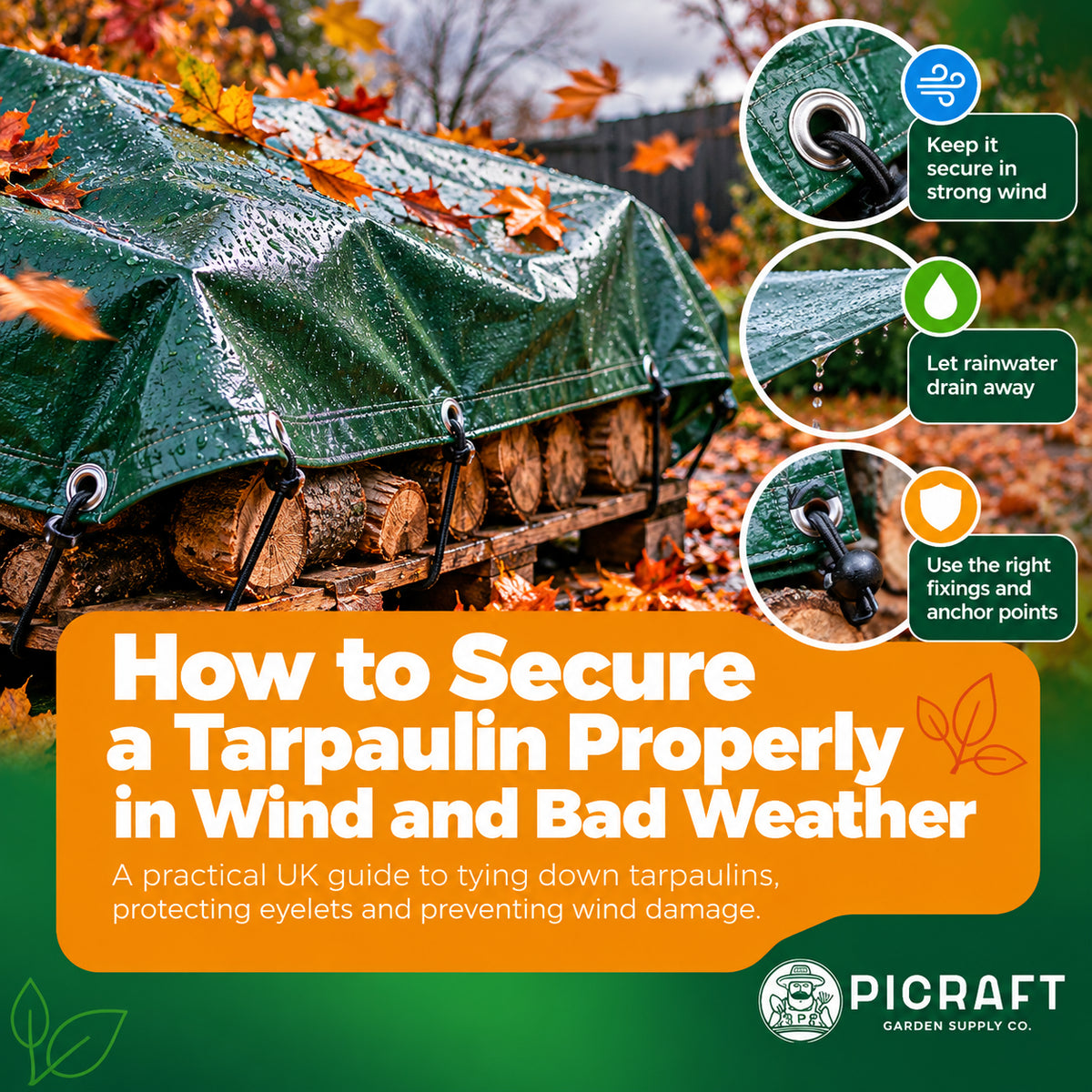
The Practical UK Guide to Tying Down Tarpaulins, Protecting Eyelets and Preventing Wind Damage
Picraft Garden Guide | Tarpaulins, Outdoor Protection & DIY
You've covered your garden furniture, firewood or building materials with a tarpaulin.
Everything looks protected.
Then the wind picks up.
The corners start lifting, the sheet begins flapping, and suddenly you're wondering whether the cover will still be there in the morning.
Sound familiar?
A tarpaulin is one of the simplest ways to protect outdoor belongings from rain, dirt and the elements. But even a strong, heavy-duty cover can fail if it isn't secured correctly.
And the problem isn't always the tarpaulin itself.
Loose edges, unsuitable fixings, weak anchor points and trapped rainwater can all contribute to damage.
A properly secured tarpaulin should minimise flapping, distribute tension across suitable fixing points and allow rainwater to drain away.
In this Picraft Garden Guide, we'll explain how to secure a tarpaulin step by step, which fixings to use, what mistakes to avoid and how to protect your outdoor equipment during unpredictable British weather.
Quick Answer: What's the Best Way to Secure a Tarpaulin in Wind?
The best way to secure a tarpaulin is to use a correctly sized cover, fasten it to strong anchor points, distribute tension across multiple reinforced eyelets and prevent wind from getting underneath loose edges.
For most suitable domestic covering applications:
-
Choose a tarpaulin that fits the item without excessive loose material.
-
Position it so rainwater can run off.
-
Protect the fabric from sharp corners and abrasive surfaces.
-
Secure the corners first using suitable fixings.
-
Fasten additional eyelets along the edges.
-
Adjust the tension evenly to minimise flapping.
-
Check that the anchor points are secure and the cover cannot become airborne.
-
Inspect the installation regularly, particularly before forecast windy weather.
Bungee cords can be useful for some applications because they allow limited movement and help absorb gusts.
However, elastic fixings must be correctly rated, securely attached and used within their manufacturer's limits.
Important: No ordinary garden tarpaulin or DIY tie-down arrangement should be assumed safe in severe storms. If damaging winds are forecast, bringing items indoors or removing an exposed cover in advance may be the safer option.
1. Why Tarpaulins Come Loose in Strong Wind
Wind doesn't simply push against a tarpaulin.
It can create pressure differences around the material, causing sections to lift, pull and move repeatedly.
If air gets underneath a loose edge, the sheet can behave like a sail.
This places stress on the fixing points.
Loose fabric catches the wind
Excess material can flap repeatedly.
Over time, this movement may weaken seams, damage eyelets or cause abrasion.
Too few fixing points concentrate the force
If a large tarpaulin is held only at four corners, much of the wind load is transferred through those points.
Adding suitable intermediate fixings can distribute the load more evenly.
Weak anchors can fail
A strong tarpaulin is of little use if it is attached to unstable furniture, a loose fence panel or an unsuitable ground peg.
The anchor must be capable of resisting the forces involved.
Rainwater increases the load
Water collecting in unsupported sections adds weight and tension.
This may stretch the material or damage seams and fixing points.
Sharp edges wear through the fabric
Wind can cause the tarpaulin to rub repeatedly against corners, screws, metal edges or rough timber.
Even a relatively small amount of movement can eventually damage the cover.
Picraft Tip: Before choosing stronger fixings, identify why the cover is moving. The problem may be its size, shape, anchor points or the way it has been positioned.
2. Choose the Right Tarpaulin Size Before You Start
One of the most common mistakes is choosing a tarpaulin that is much larger than necessary.
A little extra material is useful for overlap and securing the cover.
Too much can create loose sections that catch the wind.
Measure the item properly
Measure the length and width of the object.
Then consider its height and how far the tarpaulin needs to extend down the sides.
For example, covering a rectangular stack of timber requires more material than simply matching the stack's footprint.
Allow for secure overlap
You need enough material to cover the object and reach suitable fixing points.
However, avoid leaving large unsupported flaps.
Consider the actual sheet dimensions
Tarpaulins may be sold using nominal or cut sizes, and finished dimensions can differ depending on manufacturing and hemming.
Check the product description before ordering.
Avoid stretching a cover to make it fit
If a tarpaulin is too small, forcing it over an object can place excessive tension on the eyelets and seams.
A correctly sized cover should sit over the object without being pulled beyond its intended dimensions.
Remember: Bigger isn't automatically better. A well-fitting tarpaulin is generally easier to secure than an oversized one.
3. Understand Tarpaulin Eyelets and Fixing Points
Most general-purpose tarpaulins have metal or reinforced eyelets positioned along their edges.
These allow ropes, bungee cords and other suitable fixings to be attached.
But eyelets have limits.
What are tarpaulin eyelets?
Eyelets are reinforced openings designed to provide attachment points.
They are commonly positioned within folded or reinforced hems.
The strength of the fixing depends on several factors, including:
-
Eyelet material and construction.
-
Reinforcement around the opening.
-
Tarpaulin fabric and weight.
-
Direction of the pulling force.
-
Condition of the cover.
-
Type of fixing used.
Why do eyelets tear out?
An eyelet may fail when excessive force is concentrated around a small area.
This can happen when:
-
Only a few eyelets are used.
-
The tarpaulin is pulled too tightly.
-
Wind repeatedly lifts the cover.
-
Water accumulates on the sheet.
-
The fabric has already weakened.
-
The fixing pulls at an unsuitable angle.
Should you use every eyelet?
For many ordinary covering applications, using all suitable available eyelets helps distribute tension and reduce loose edges.
However, every attachment must connect to an appropriate anchor.
Do not assume that more fixings automatically make an unsafe structure stormproof.
Can you add extra eyelets?
Additional eyelets may be possible with suitable reinforcement and equipment.
However, installing them incorrectly can weaken the material.
Where a manufacturer provides specific attachment instructions, follow those instructions.
4. Rope, Bungee Cords or Straps: Which Is Best?
Different fixing methods have different advantages.
The right choice depends on the tarpaulin, what you're covering and the conditions.
Bungee Cords
Bungee cords are elastic fixings that stretch under load.
Advantages:
-
Allow limited movement.
-
Can help absorb some gusts.
-
Convenient for suitable eyelet attachments.
-
Easy to remove and reposition.
Limitations:
-
Can overstretch.
-
May deteriorate with age and UV exposure.
-
Hooks can detach or become dangerous if released.
-
Not suitable for every load or anchoring arrangement.
Always inspect elastic cords before use and keep your face and body out of their potential recoil path.
Rope
Rope provides a less elastic connection.
Advantages:
-
Available in different materials and strengths.
-
Useful for tying around suitable fixed structures.
-
Can be adjusted using appropriate knots.
-
Suitable for many general outdoor covering tasks.
Limitations:
-
Excessive tension can damage eyelets.
-
Some ropes stretch or loosen when wet.
-
Knots can slip if incorrectly tied.
-
Abrasion can weaken the rope.
Ratchet Straps
Ratchet straps can generate substantial tension.
They may be suitable for certain heavy-duty securing applications when the equipment and anchor points are designed for the load.
However, they can also apply enough force to tear a tarpaulin or damage the object underneath.
Do not use high-tension straps directly through ordinary lightweight tarpaulin eyelets unless the manufacturer specifically permits it.
Ground Pegs
Ground pegs can help secure suitable covers at ground level.
Their effectiveness depends on soil conditions, peg design and the forces involved.
Loose or waterlogged ground may provide poor holding strength.
Tarpaulin Clips
Purpose-made tarpaulin clips can provide additional attachment options where compatible.
They should be used according to their rated capacity and manufacturer instructions.
Do not assume that a clip attached to unsupported fabric will withstand severe wind loads.
Quick Comparison
| Fixing | Main advantage | Main consideration |
|---|---|---|
| Bungee cord | Controlled elasticity | Recoil risk and stretching limits |
| Rope | Versatile and adjustable | Knot security and tension |
| Ratchet strap | High tension capacity | Can overload eyelets or damage objects |
| Ground peg | Convenient ground anchoring | Depends on ground conditions |
| Tarpaulin clip | Additional attachment point | Fabric and clip strength |
Picraft Tip: For ordinary garden covers, suitable elastic fixings are often practical. But the strength of the anchor points and the overall installation matters more than any single accessory.
5. How to Secure a Tarpaulin Properly: Step-by-Step
Here's a practical method for securing a general-purpose tarpaulin over a stable outdoor object.
Step 1: Check the Weather Forecast
Before beginning, assess the expected conditions.
If strong winds or severe weather warnings are forecast, consider whether covering the item outdoors is appropriate at all.
Do not attempt to install or adjust a large tarpaulin during dangerous winds.
Step 2: Prepare the Object
Make sure the item you're covering is stable.
Remove or protect sharp edges.
For example, exposed corners on stacked timber or metal equipment may require suitable padding.
Avoid using loose materials that could themselves blow away.
Step 3: Position the Tarpaulin
Place the cover centrally over the object.
Make sure the sheet reaches the intended sides without being excessively stretched.
Avoid leaving large loose sections.
Step 4: Create a Suitable Slope
Where rain protection is required, arrange the cover so water can drain away.
A sloping or supported surface is usually preferable to a flat area where water can collect.
Make sure runoff is directed away from places where it could cause damage.
Step 5: Secure Opposite Corners
Using suitable fixings and strong anchors, attach the corners.
Work between opposite corners and adjust the position gradually.
Do not pull one corner excessively tight while leaving the others loose.
Step 6: Secure Intermediate Eyelets
Fasten suitable eyelets along the remaining edges.
This helps distribute tension and control loose material.
Keep the cover evenly positioned.
Step 7: Adjust the Tension
The goal is to reduce uncontrolled movement without overstressing the fabric.
A tarpaulin does not need to be stretched like a drum.
It should be sufficiently controlled to minimise flapping while remaining within the limits of its material and fixings.
Step 8: Check the Anchors
Make sure the fixings cannot easily slip, detach or pull free.
Check that no sharp hooks or loose ends create hazards.
Step 9: Inspect the Finished Cover
Look for:
-
Loose corners.
-
Unsupported flaps.
-
Excessive tension around eyelets.
-
Sharp contact points.
-
Areas where rainwater could collect.
-
Unstable anchor points.
-
Loose cords or hooks.
If the arrangement is exposed to significant wind, consider whether a different covering or storage solution is needed.
6. How to Stop a Tarpaulin from Flapping in the Wind
Flapping is more than an annoying noise.
Repeated movement can place stress on the material, eyelets and seams.
It can also cause the tarpaulin to rub against the item underneath.
Reduce Loose Material
Choose a suitable size and position the sheet carefully.
Fold or secure excess material only where this can be done without creating new wind-catching pockets.
Use More Suitable Fixing Points
Intermediate fixings can help prevent large sections from lifting.
Improve the Shape
A smooth, supported cover is generally less likely to flap than a loose sheet suspended over an uneven object.
Reduce Wind Entry
Where practical, secure the lower edges so gusts cannot easily get underneath.
Do not create sealed enclosures that trap moisture around items requiring ventilation.
Consider Additional Support
For suitable large covers, a properly designed restraint or support system may help control movement.
Any additional rope or strap must be compatible with the cover and the load, and must not create unsafe pressure points.
Important: If the tarpaulin continues to lift strongly or the anchor points are moving, don't simply pull the cords tighter. Reassess the installation.
7. How to Prevent Rainwater from Pooling on a Tarpaulin
Rainwater pooling is one of the most overlooked causes of tarpaulin damage.
A shallow depression can gradually collect a significant amount of water.
And water is heavy.
One litre of water weighs approximately one kilogram.
This means a pocket containing 20 litres of rainwater adds roughly 20 kilograms of load.
That load may be concentrated on seams, eyelets or unsupported fabric.
Why Does Pooling Happen?
Common causes include:
-
Flat installations.
-
Unsupported areas.
-
Sagging fabric.
-
Uneven objects underneath.
-
Insufficient slope.
-
Stretched or loosened fixings.
How to Reduce Pooling
-
Create a suitable drainage slope.
-
Support areas that would otherwise sag.
-
Use an appropriately sized cover.
-
Check that the sheet remains correctly positioned.
-
Inspect the cover after rainfall when conditions are safe.
Avoid placing unstable objects beneath the tarpaulin to create height.
Supports must be secure and should not create sharp pressure points.
Where Should Water Drain?
Direct runoff away from vulnerable surfaces, doors, electrical equipment and places where pooling could create another problem.
Picraft Tip: A tarpaulin that sheds rain efficiently is generally better protected from water-related strain than one that allows puddles to form.
8. How to Secure a Tarpaulin Over Garden Furniture
Garden furniture is one of the most common items protected by tarpaulins.
However, chairs, tables and outdoor seating can have irregular shapes.
These can make securing a cover more difficult.
Choose a Suitable Cover
Measure the furniture arrangement.
Avoid a cover that is unnecessarily large.
Protect Sharp Corners
Metal frames, table edges and protruding fittings can wear through fabric.
Use Stable Attachment Points
Secure the tarpaulin to suitable stable parts of the furniture or another properly designed anchoring arrangement.
Do not rely on lightweight chairs or unsecured objects as anchors.
Allow Appropriate Ventilation
Trapped condensation can contribute to dampness and mould on certain materials.
Follow furniture manufacturers' storage recommendations.
Consider Bringing Lightweight Furniture Indoors
During severe weather, storing lightweight furniture in a shed or garage may be safer than leaving it outdoors under a large cover.
9. How to Secure a Tarpaulin Over Firewood
Firewood needs protection from rain, but it also needs ventilation.
A common mistake is wrapping the entire stack tightly in plastic.
This can trap moisture and slow drying.
Cover the Top
A suitable overhead cover can help prevent rain from soaking the stack.
Allow Airflow
Where practical, leave appropriate ventilation around the sides.
Raise Wood Off the Ground
Using a suitable stable base can help reduce direct contact with wet ground.
Secure the Cover Independently
Use suitable fixings and anchors so the cover cannot blow away.
Avoid relying on loose logs or unstable weights.
Prevent Water Pooling
Create a suitable slope and keep runoff away from the stack.
Picraft Tip: Firewood protection is about keeping excessive rain off while allowing moisture to escape.
10. How to Cover Building Materials and DIY Supplies
Tarpaulins are commonly used to protect timber, sand, aggregates and other materials during outdoor projects.
However, different materials require different storage conditions.
Timber
Keep timber supported and protected from prolonged direct exposure to rain.
Allow appropriate airflow to reduce trapped moisture.
Sand and Aggregates
A suitable tarpaulin may help limit contamination and excess rainfall.
Secure the edges so wind cannot lift the sheet.
Tools and Equipment
Some equipment may require fully enclosed, dry storage rather than a general-purpose tarpaulin.
Check the manufacturer's recommendations.
Cement and Moisture-Sensitive Products
Products such as bagged cement may be damaged by moisture.
A tarpaulin alone may not provide adequate protection during prolonged outdoor storage.
Use suitable dry storage according to the product instructions.
Construction Sites
Temporary covers used on scaffolding, roofs or elevated structures can experience substantial wind forces.
These applications require appropriate design, equipment and competent installation.
Do not use ordinary garden tarpaulin fixing advice as a substitute for professional temporary-works design or fall protection.
11. Does Tarpaulin GSM Matter in Strong Wind?
Yes, but GSM is only part of the picture.
GSM stands for grams per square metre.
It describes the weight of the material per unit area.
Higher-GSM tarpaulins are generally heavier, but this does not automatically mean they are suitable for every windy environment.
What Else Matters?
-
Fabric construction.
-
Material type.
-
Reinforcement.
-
Eyelet design.
-
Seam quality.
-
UV resistance.
-
Age and condition.
-
Installation method.
-
Exposure to wind.
Lightweight Tarpaulins
Often used for temporary, general-purpose covering where conditions and loads are suitable.
Medium-Weight Tarpaulins
May provide a useful balance of handling and durability for many domestic applications.
Heavy-Duty Tarpaulins
Can offer greater robustness depending on construction, but still require proper installation.
PVC Tarpaulins
Some PVC-coated products are designed for more demanding applications.
However, specifications and performance vary considerably.
A heavier tarpaulin attached incorrectly can still fail.
Always consider the complete covering system.
12. Can You Use Bricks or Heavy Objects to Hold a Tarpaulin Down?
Placing bricks, stones or other heavy objects on a tarpaulin may seem convenient.
But this method has limitations and can create hazards.
Why Loose Weights Can Be a Problem
-
Wind may lift the cover beneath them.
-
Weights may shift or fall.
-
Hard edges may damage the material.
-
Loose objects can become dangerous in strong winds.
-
The arrangement may not provide reliable resistance to uplift.
For exposed areas, use properly designed and suitably rated anchors or secure storage arrangements rather than relying on loose weights.
If a tarpaulin cannot be secured safely, reconsider whether it should remain outdoors.
13. What Should You Do Before a Storm?
This is where tarpaulin safety becomes especially important.
Strong winds can turn loose covers and outdoor objects into hazards.
Before Strong Winds Arrive
-
Check the latest weather forecast and warnings.
-
Inspect tarpaulins for tears and worn eyelets.
-
Check ropes, bungees and anchor points.
-
Remove or secure loose outdoor objects.
-
Bring vulnerable furniture and equipment indoors where practical.
-
Consider removing large exposed tarpaulins in advance if they cannot be made safe.
-
Avoid leaving unstable temporary structures outdoors.
During a Storm
Do not go outside to repair or retighten a tarpaulin during dangerous winds.
A flapping cover can move unpredictably, and loose fittings may cause injury.
Stay in a safe location and follow official weather advice.
After the Storm
When conditions are safe:
-
Inspect the cover.
-
Check the eyelets and seams.
-
Examine anchor points.
-
Look for abrasion and tears.
-
Remove trapped water where it is safe to do so.
-
Replace damaged fixings before reusing the cover.
A damaged tarpaulin should not be assumed safe simply because it survived one storm.
14. The Most Common Tarpaulin Securing Mistakes
Mistake 1: Using Only Four Corners
This may leave large areas unsupported and concentrate force on a small number of eyelets.
Mistake 2: Pulling the Tarpaulin Too Tight
Excessive tension can damage fabric, seams or fixing points.
Mistake 3: Leaving Loose Edges
Wind can enter beneath the sheet and cause it to lift.
Mistake 4: Ignoring Rainwater Drainage
Pooling water increases the load on the cover.
Mistake 5: Using Weak Anchor Points
A fixing is only as reliable as the structure holding it.
Mistake 6: Allowing Sharp Edges to Rub
Repeated movement can cause abrasion and tearing.
Mistake 7: Choosing by GSM Alone
Material weight does not tell you everything about wind resistance.
Mistake 8: Using Damaged Bungee Cords
Old or damaged elastic cords may fail unexpectedly.
Mistake 9: Treating a Tarpaulin as a Permanent Roof
Ordinary general-purpose tarpaulins are not automatically suitable for permanent structural covering.
Mistake 10: Trying to Repair a Cover During a Storm
No outdoor item is worth risking personal injury.
15. Your Tarpaulin Securing Checklist
Before leaving your tarpaulin in place, ask yourself:
1. Is the tarpaulin the right size?
Avoid excessive loose material.
2. Are the anchor points strong and stable?
Never rely on weak or unstable objects.
3. Have I used enough suitable fixing points?
Distribute tension where the design permits.
4. Are the eyelets in good condition?
Look for tearing or deformation.
5. Can rainwater drain away?
Avoid unsupported pockets.
6. Is the fabric protected from sharp edges?
Check all contact points.
7. Can wind easily get underneath?
Control loose edges without trapping unwanted moisture.
8. Are my ropes, cords and straps suitable?
Inspect their condition and follow manufacturer limits.
9. Is the weather forecast appropriate?
Reassess before strong winds.
10. Would indoor storage be safer?
Sometimes the best solution is not another fixing — it's moving the item.
Frequently Asked Questions
What is the best way to stop a tarpaulin blowing away?
Use a properly sized cover, suitable anchor points and multiple reinforced fixing points. Minimise loose edges and flapping, and reassess the arrangement before strong winds.
Are bungee cords better than rope for tarpaulins?
Bungee cords can help absorb limited movement, while rope offers a less elastic connection. The best option depends on the application, loads and manufacturer instructions.
Should a tarpaulin be tight or loose?
It should be sufficiently controlled to minimise flapping without excessive tension on the material or eyelets.
How do I stop tarpaulin eyelets tearing?
Use suitable fixings, distribute loads across reinforced attachment points, avoid excessive tension and minimise uncontrolled movement.
How do I stop water pooling on a tarpaulin?
Create a suitable slope, support sagging areas and position the sheet so rainwater drains away.
Can I secure a tarpaulin with bricks?
Loose bricks and stones are not reliable anchors for windy conditions and may create hazards. Properly designed fixing arrangements are preferable.
Is a heavy-duty tarpaulin windproof?
No ordinary tarpaulin should be assumed windproof. Performance depends on material, construction, installation and weather conditions.
Does a higher GSM mean a stronger tarpaulin?
Not necessarily. GSM measures material weight per square metre. Tear resistance, reinforcement and other construction details also matter.
How many eyelets should I use?
Use suitable reinforced fixing points as appropriate to the cover and application. Distributing tension across multiple points generally reduces concentrated loading.
Can I leave a tarpaulin outside all winter?
Some tarpaulins are suitable for extended outdoor use, depending on their specifications and installation. Regular inspections and weather-related precautions remain important.
How do I secure a tarpaulin over firewood?
Cover the top of the stack, provide suitable ventilation, create drainage and use secure anchors that cannot easily become dislodged.
What should I do if my tarpaulin comes loose during a storm?
Do not attempt dangerous outdoor repairs while the storm is underway. Wait until conditions are safe before inspecting or replacing the cover.
Final Thoughts: A Secure Tarpaulin Is About More Than Strong Fabric
A tarpaulin can be an excellent way to protect garden furniture, equipment, firewood and building materials.
But its effectiveness depends on how it is installed.
Choosing a suitable size, protecting sharp edges, distributing tension and allowing rainwater to drain can make a substantial difference.
And when bad weather is forecast, preparation matters.
The best tarpaulin setup is one that protects your belongings without creating a new hazard.
Before the next windy day, take a few minutes to check your covers, fixings and anchor points.
A little preparation can help prevent damaged materials, torn eyelets and unwanted surprises after a night of bad weather.
Continue Exploring Picraft Garden Guide
Discover more practical guides:
-
How to Choose the Right Tarpaulin for Your Garden
-
Tarpaulin GSM Explained: What Weight Do You Actually Need?
-
How to Protect Garden Furniture, Equipment and Materials with Tarpaulins This Winter
-
90L Mixing Tub: 7 Practical Uses Around the Home, Garden & Building Site
Explore tarpaulins, garden supplies and practical outdoor accessories at Picraft Garden Supply Co..
🌿 Picraft Garden Guide
Practical advice for your garden, home & outdoor projects.