
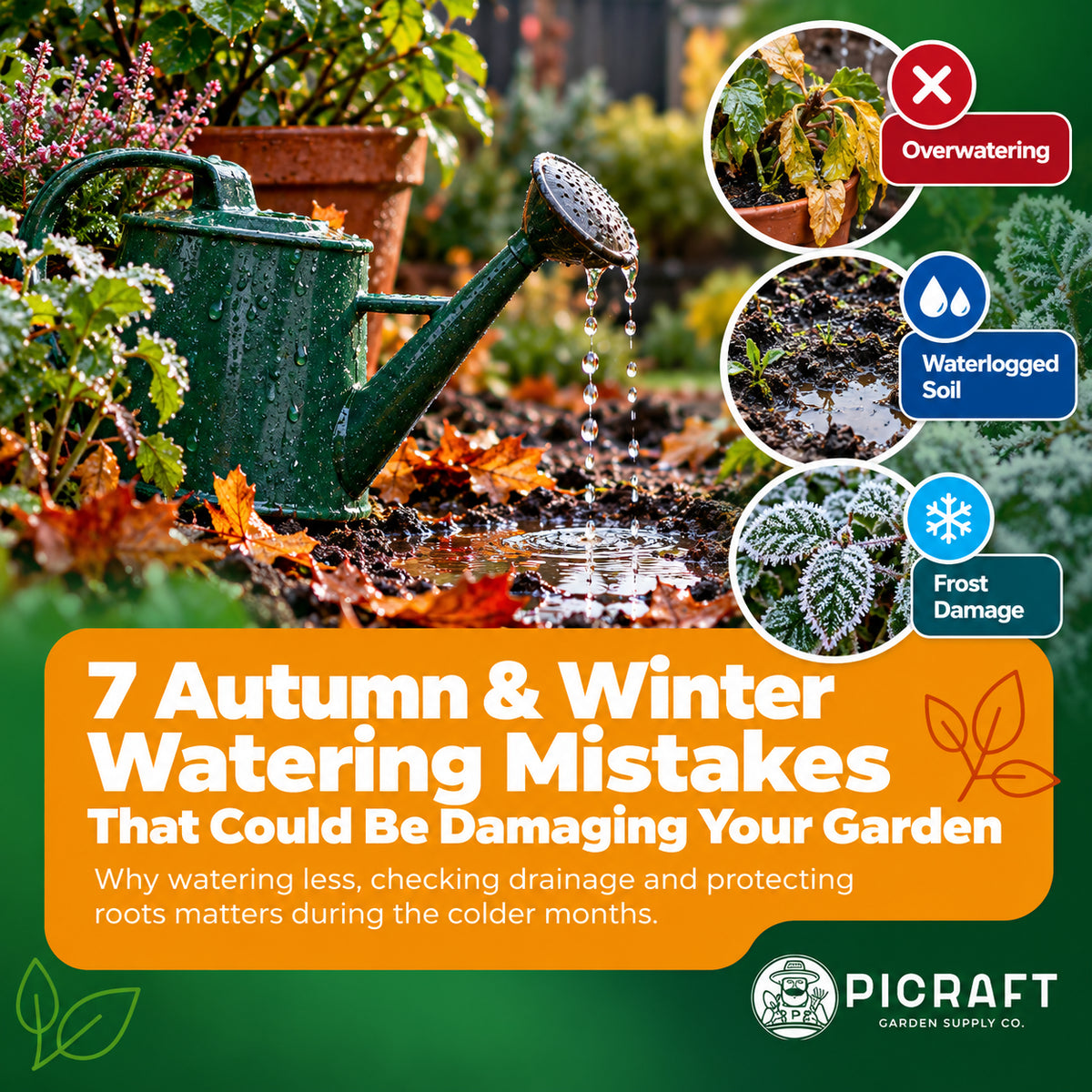
Why Watering Less, Checking Drainage and Protecting Roots Matters During the Colder Months
Picraft Garden Academy | Seasonal Gardening, Soil Health & Smarter Watering
When November arrives in Britain, watering the garden is probably the last thing on your mind.
The days are shorter, temperatures are falling, and rain seems to arrive almost every other day.
Surely your plants have all the water they need?
Often, they do.
But autumn and winter introduce a different set of watering problems — and some of the most damaging mistakes happen when gardeners continue treating their plants as though it were summer.
Watering too frequently, ignoring waterlogged soil, forgetting sheltered containers and leaving irrigation systems running into freezing weather can all cause unnecessary problems.
And there's another surprise.
Even in a wet British winter, some plants can still suffer from a lack of water.
The secret is understanding when water helps your plants — and when it makes conditions worse.
In this Picraft Garden Academy guide, we'll explore seven common cold-weather watering mistakes, how to recognise them and what to do instead.
Quick Answer: Should You Water Your Garden in Autumn and Winter?
Most established UK garden plants need little or no additional watering during a typical wet autumn or winter. However, newly planted trees, evergreen shrubs and sheltered container plants may still require water during dry periods.
The biggest cold-weather watering mistakes include:
-
Continuing a summer watering schedule.
-
Giving every plant the same amount of water.
-
Ignoring waterlogged soil and poor drainage.
-
Watering without checking moisture around the roots.
-
Forgetting plants in sheltered pots and containers.
-
Watering during freezing conditions.
-
Failing to switch off and protect irrigation equipment.
The most important rule is simple:
Check the soil and the plant before deciding to water — not just the calendar or weather forecast.
Why Watering Changes So Much in Autumn and Winter
During spring and summer, many garden plants are actively growing.
Longer days, warmer temperatures and stronger sunlight increase water demand.
Plants absorb water through their roots and release much of it into the atmosphere through their leaves.
This process is known as transpiration.
As autumn progresses, conditions change.
Daylight decreases, temperatures fall and many deciduous plants begin entering dormancy.
Evaporation from the soil generally slows down.
In many gardens, rainfall also becomes more frequent or the soil remains damp for longer between showers.
The result?
Water can remain in the root zone much longer than it would during summer.
However, not every plant behaves the same way.
Evergreen plants retain their foliage and may continue losing moisture during winter.
Newly planted shrubs may have limited root systems.
Pots beneath roof overhangs can remain dry even when the surrounding garden is soaked.
Understanding these differences is the foundation of good winter watering.
Mistake 1: Continuing Your Summer Watering Schedule
The mistake
You've spent the summer watering your garden every few days.
Perhaps you've even installed an automatic irrigation timer.
Autumn arrives, but the schedule stays exactly the same.
The problem is that your garden's water demand may have changed dramatically.
A watering routine that was useful during a hot July could leave the soil unnecessarily wet in November.
Why it can damage plants
Excessive watering may cause soil to remain saturated.
When too much water occupies the spaces between soil particles, less oxygen is available to plant roots.
Roots need oxygen for normal respiration and healthy functioning.
Prolonged saturation can interfere with nutrient uptake and contribute to root deterioration.
Signs to look for
-
Soil remaining wet for long periods.
-
Water collecting around planting areas.
-
Yellowing leaves without obvious drought.
-
Slow or unhealthy growth.
-
Damp, poorly aerated compost.
-
An automatic irrigation system running despite frequent rainfall.
These symptoms can have several causes, so they should not be treated as proof of overwatering without checking the soil.
What to do instead
Reduce watering as temperatures fall and plant growth slows.
For automatic systems, review the schedule regularly rather than allowing summer settings to continue unchanged.
During consistently wet weather, supplementary irrigation may not be needed at all.
Before watering, check moisture at an appropriate depth.
Picraft Garden Tip
A watering timer can make gardening easier, but it cannot automatically tell whether the soil is already wet unless suitable sensing or weather-based controls are included.
The best watering schedule is one that changes with the conditions.
Mistake 2: Treating Every Plant as Though It Needs the Same Amount of Water
The mistake
You look around the garden and decide everything should receive the same amount of water.
The lawn, shrubs, vegetables, hanging baskets and newly planted trees are all treated identically.
But their needs can be very different.
Why plant type matters
Consider these examples.
Established deciduous trees
During winter dormancy, their water demand is generally low.
Newly planted trees and shrubs
Their roots may still be confined to a relatively small area.
They can be vulnerable to drying out before becoming fully established.
Evergreen shrubs
Plants such as certain conifers, hollies and other evergreens retain leaves throughout winter.
They may continue losing water, particularly during dry, windy conditions.
Container plants
Pots have limited growing-medium volume and may dry out independently of the surrounding garden soil.
Winter vegetables
Some crops remain actively growing during milder periods and may still require suitable moisture.
What to do instead
Divide your garden into groups according to plant requirements.
| Plant type | Typical autumn/winter watering needs | What to monitor |
|---|---|---|
| Established deciduous trees | Usually minimal | Unusual prolonged dryness |
| Established shrubs | Often low | Soil condition and species requirements |
| Newly planted trees and shrubs | May need occasional watering | Moisture within the original root ball |
| Evergreen shrubs | Variable | Dry, windy periods and root-zone moisture |
| Sheltered containers | Can still dry out | Compost moisture and drainage |
| Winter vegetables | Depends on crop and conditions | Active growth and soil moisture |
| Established lawns | Usually little supplementary water | Unusual drought conditions |
These are general guidelines, not fixed watering schedules.
Picraft Garden Tip
Water according to root development, growing conditions and plant type — not simply because everything is growing in the same garden.
Mistake 3: Ignoring Waterlogged Soil and Poor Drainage
The mistake
Your garden has received days of rain.
The lawn feels soft, planting beds are saturated and puddles remain long after showers have stopped.
You assume that because plants need water, wet soil must be good for them.
Unfortunately, that isn't always true.
Why waterlogging is dangerous
Healthy soil contains a mixture of solid particles, water and air.
The spaces between soil particles allow water and oxygen to move through the root zone.
When these spaces remain filled with water for too long, oxygen availability falls.
This can interfere with root respiration and create conditions that favour certain root diseases.
Why British gardens can be vulnerable
Some UK gardens contain heavy clay soils.
Clay can retain substantial amounts of moisture and may drain slowly, especially when compacted.
Other gardens have drainage problems caused by:
-
Repeated foot traffic.
-
Construction-related soil compaction.
-
Poorly designed planting areas.
-
Depressions where rainwater collects.
-
Impermeable surfaces directing runoff into beds.
-
Containers with blocked drainage holes.
Warning signs
-
Puddles remaining long after rainfall.
-
Persistently saturated soil.
-
Unpleasant smells from poorly aerated soil.
-
Plants struggling despite abundant moisture.
-
Soft, muddy lawns.
-
Water standing in plant saucers.
What to do instead
1. Stop unnecessary watering.
Adding more water will not solve saturated soil.
2. Avoid walking on wet soil.
Foot traffic can worsen compaction, particularly on heavy soils.
3. Check container drainage.
Make sure drainage holes are clear and pots are not sitting in standing water.
4. Consider improving soil structure.
Suitable organic matter and careful soil management can help improve structure over time.
Avoid working heavy clay when it is very wet.
5. Investigate persistent drainage problems.
Some gardens may benefit from raised beds, appropriate planting choices or professionally assessed drainage improvements.
Picraft Garden Tip
Healthy roots need oxygen as well as water.
A garden that is constantly wet is not necessarily a healthy garden.
Mistake 4: Watering Without Checking Moisture Below the Surface
The mistake
The top of the soil looks dry, so you water.
Or perhaps the surface looks wet after rain, so you assume the roots have enough moisture.
Both assumptions can be misleading.
Why surface moisture doesn't tell the whole story
The upper layer of soil is exposed directly to wind, rainfall and temperature changes.
It can behave differently from the deeper root zone.
For example:
-
A brief shower may wet only the surface.
-
The surface may dry while deeper soil remains moist.
-
A newly planted shrub's original root ball may be dry even when surrounding soil is damp.
-
Water may run off compacted soil without penetrating effectively.
How to check soil moisture properly
Step 1: Choose a representative location.
Check near the plant's root zone without damaging important roots.
Step 2: Inspect beneath the surface.
Use your fingers or a small trowel to assess moisture at a depth relevant to the plant.
Step 3: Consider the soil type.
Sandy and clay soils feel different when moist.
Step 4: Check the plant's condition.
Look for signs of stress, but remember that wilting and yellowing are not always caused by drought.
Step 5: Make a decision.
If the root zone is sufficiently moist, watering may be unnecessary.
What about moisture meters?
Soil moisture meters can provide additional information.
However, readings depend on the device, growing medium and correct use.
For many home gardeners, physical soil inspection remains a useful starting point.
Picraft Garden Tip
Don't water because the surface looks dry. Check where the roots actually are.
Mistake 5: Forgetting About Pots and Plants Sheltered from Rain
The mistake
It has rained for three days.
You assume every plant in the garden has received plenty of water.
But what about the pots beside the house?
Or the hanging basket beneath the porch?
Or the evergreen shrub sitting under a roof overhang?
These areas may receive surprisingly little rainfall.
Why sheltered plants are different
Buildings, fences, overhanging roofs and other structures can create rain shadows.
This means rainfall does not reach every part of the garden equally.
Container plants also have a limited volume of compost.
Their moisture conditions can change independently of the soil in surrounding borders.
Which plants should you check?
-
Pots near house walls.
-
Containers beneath porches.
-
Hanging baskets under roof overhangs.
-
Plants in covered patios.
-
Greenhouse plants.
-
Newly planted shrubs beneath dense evergreen canopies.
What to do instead
Inspect sheltered plants periodically.
Check the compost rather than relying on rainfall elsewhere.
If watering is necessary, apply water appropriately and allow excess to drain.
Avoid leaving containers standing in water during cold, wet weather.
Don't forget frost protection
Some container plants are more vulnerable to freezing because their roots are exposed to colder conditions than those of plants growing in the ground.
Move vulnerable pots to suitable sheltered locations where appropriate, following the plant's care requirements.
Picraft Garden Tip
A wet garden doesn't always mean wet pots.
Sheltered containers deserve their own moisture checks throughout autumn and winter.
Mistake 6: Watering During Freezing Conditions
The mistake
You notice that a plant looks dry on a freezing morning.
You reach for the hose and start watering immediately.
But when the ground is frozen, adding water may not help.
It can also create slippery surfaces and additional ice.
Why freezing weather changes water availability
When soil freezes, water movement and root activity can be restricted.
Even plants surrounded by moisture may struggle to access it.
Evergreens can be particularly vulnerable during cold, dry winds because their foliage may continue losing moisture while frozen ground limits replacement from the roots.
Should you ever water in winter?
Yes — when it is genuinely needed and conditions are suitable.
For example, a sheltered evergreen container may become dry during a prolonged period without rainfall.
If the compost is dry and unfrozen, carefully watering during a suitable milder period may be appropriate.
What to avoid
-
Watering frozen ground.
-
Creating icy paths or patios.
-
Leaving water standing around vulnerable plants.
-
Using hoses that may contain frozen water.
-
Assuming every winter wilt is caused by dry soil.
A better approach
Check moisture before watering.
If the soil is frozen, wait until it has thawed and conditions are suitable.
Consider whether the plant's symptoms could be caused by cold exposure, waterlogging or another problem.
Picraft Garden Tip
Winter watering should respond to genuine moisture needs — not become an automatic routine.
Mistake 7: Leaving Your Irrigation System Running Into Winter
The mistake
Your automatic irrigation system worked perfectly throughout summer.
Autumn arrives, but you forget to change its settings.
Then temperatures fall below freezing.
Now you have two potential problems:
-
Your garden may be receiving unnecessary water.
-
Water trapped in exposed equipment may freeze and cause damage.
Why winter preparation matters
Water expands when it freezes.
If water is trapped inside vulnerable hoses, timers, valves or fittings, freezing conditions can damage components.
The level of risk depends on the equipment and how it is installed.
What should you check?
Garden hoses
Disconnect and drain hoses where appropriate.
Store them according to the manufacturer's guidance.
Outdoor tap timers
Battery-operated or electronic timers may require removal and indoor storage.
Check their instructions.
Drip irrigation systems
Some systems can be drained or winterised.
Follow the manufacturer's specific procedure.
Sprinklers
Remove or protect equipment that is not designed to remain exposed to freezing conditions.
Automatic controllers
Review seasonal watering schedules and deactivate unnecessary programmes.
Water butts and connectors
Inspect fittings, overflow arrangements and frost-related guidance for the particular system.
A Simple Winter Irrigation Checklist
-
Turn off unnecessary watering programmes.
-
Disconnect vulnerable equipment.
-
Drain hoses where required.
-
Inspect exposed connectors.
-
Follow manufacturer-specific winterisation instructions.
-
Store removable components appropriately.
-
Check the system before restarting it in spring.
Picraft Garden Tip
A few minutes of irrigation maintenance in autumn can help avoid unnecessary watering and damaged equipment in winter.
8. Why November Is the Perfect Time to Review Your Watering Habits
November marks an important transition for many British gardens.
By this point, much of the rapid summer growth has slowed.
Deciduous trees are losing their leaves.
Temperatures are falling, and many areas experience prolonged periods of damp weather.
But November conditions vary significantly across the UK.
A garden in western Scotland may experience very different rainfall from one in eastern England.
Some years are unusually wet.
Others include relatively dry periods.
That's why fixed seasonal rules are not always reliable.
What Should UK Gardeners Do in November?
Check the garden after rainfall.
Look for areas where water collects.
Inspect newly planted shrubs and trees.
Make sure their root balls are neither persistently saturated nor excessively dry.
Review containers.
Check both sheltered and exposed pots.
Reduce automatic watering.
Adjust or suspend irrigation according to actual conditions.
Prepare for frost.
Protect vulnerable equipment before freezing temperatures arrive.
Avoid unnecessary soil disturbance.
Working saturated soil can damage its structure.
Plan drainage improvements.
Identify problem areas and consider appropriate solutions when ground conditions permit.
November is an excellent month for observation.
You can learn a great deal about how your garden handles rainfall simply by watching what happens after several wet days.
9. How to Recognise Overwatering and Underwatering in Cold Weather
One of the difficulties with watering problems is that different causes can produce similar symptoms.
For example, wilting leaves may appear when roots cannot obtain enough water.
But that can happen because the soil is too dry — or because saturated soil has damaged root function.
Common Symptoms Compared
| Symptom | Possible explanation | What to check |
|---|---|---|
| Wilting leaves | Dry soil, waterlogging or cold stress | Root-zone moisture and temperature |
| Yellowing leaves | Excess moisture, seasonal changes or nutrient issues | Soil conditions and plant species |
| Dry compost | Insufficient moisture | Container position and root-zone moisture |
| Persistent puddles | Poor drainage or compacted soil | Soil structure and runoff |
| Soft, unhealthy roots | Root deterioration or disease | Drainage and growing conditions |
| Brown evergreen foliage | Drought, cold wind, root problems or other stress | Soil moisture and exposure |
| Slow winter growth | Often normal seasonal dormancy | Plant type and general health |
The Key Diagnostic Question
Before watering, ask:
Is the plant unable to access enough water because the soil is dry — or because the roots are struggling in unsuitable conditions?
Adding water only helps when additional moisture is actually needed.
10. How Soil Type Changes Winter Watering
Not all garden soils behave in the same way.
Clay Soil
Clay-rich soil can retain considerable moisture.
During prolonged rainfall, drainage may be slow, particularly when the ground is compacted.
Avoid unnecessary watering and excessive foot traffic on saturated soil.
Sandy Soil
Sandy soils generally drain more freely.
They may dry out faster during prolonged dry periods, even in cooler weather.
Newly planted shrubs in sandy soil may require closer monitoring.
Loamy Soil
Well-structured loam often provides a useful balance of water retention and drainage.
However, even loamy soil can become compacted or saturated.
Raised Beds
Raised beds may drain more readily than surrounding ground, depending on their construction and growing medium.
They can still become excessively wet or dry.
Containers
Container moisture depends on pot size, drainage, compost composition, plant type and exposure.
A pot beneath shelter can be dry while an exposed pot nearby is saturated.
Picraft Garden Tip: Understanding your soil type helps you make better decisions throughout the year, not just in winter.
11. What About Lawns in Autumn and Winter?
Lawns generally need much less supplementary watering during the colder months.
For most established UK lawns, natural rainfall is usually sufficient.
However, waterlogging can create problems.
Avoid Walking on Saturated Grass
Repeated traffic over wet ground can contribute to compaction and damage the lawn surface.
Watch for Standing Water
Persistent puddles may indicate drainage or compaction problems.
Don't Automatically Water Brown Grass
Discolouration can result from several factors, including cold weather, seasonal growth changes and disease.
Check conditions before assuming drought.
Newly Established Lawns Are Different
New turf or recently seeded areas may require more careful moisture monitoring while establishing.
Their needs depend on weather, soil and growth stage.
12. Seven Better Watering Habits for the Colder Months
Replacing poor habits with simple checks can make winter garden care much easier.
1. Let the Weather Inform Your Decisions
Use forecasts as useful context, but inspect the garden itself.
2. Check Soil Before Watering
Look beneath the surface and consider root depth.
3. Prioritise Vulnerable Plants
Pay attention to new plantings, evergreens and sheltered containers.
4. Watch for Waterlogging
Persistent saturation is a warning sign.
5. Protect Soil Structure
Avoid unnecessary digging and foot traffic when the soil is very wet.
6. Winterise Irrigation Equipment
Follow the instructions for your hoses, timers, sprinklers and fittings.
7. Accept That Sometimes the Best Watering Decision Is Not to Water
During a wet British winter, doing less can be exactly what your garden needs.
13. The Picraft Autumn & Winter Garden Watering Checklist
Before winter settles in, use this practical checklist.
Plants
☐ Check newly planted trees and shrubs.
☐ Inspect evergreen plants during prolonged dry weather.
☐ Monitor sheltered containers.
☐ Check moisture before adding water.
☐ Avoid unnecessary watering of dormant plants.
Soil and Drainage
☐ Look for standing water.
☐ Check areas prone to waterlogging.
☐ Avoid walking on saturated beds.
☐ Make sure container drainage holes are clear.
☐ Consider longer-term improvements where drainage is persistently poor.
Irrigation Equipment
☐ Review automatic watering schedules.
☐ Disconnect and drain vulnerable hoses.
☐ Protect exposed timers and fittings.
☐ Follow manufacturer winterisation instructions.
☐ Inspect the system before spring use.
Frequently Asked Questions
Should I water my garden in November in the UK?
Usually only when needed. Many established plants receive sufficient moisture from natural rainfall, but new plantings and sheltered containers may still require attention during dry periods.
Can you overwater plants in winter?
Yes. Excessive watering can contribute to saturated soil, reduced oxygen availability and poor root conditions.
How often should I water outdoor pots in winter?
There is no universal schedule. Check the compost and water only when the particular plant needs moisture and conditions are suitable.
Should I water evergreen shrubs in winter?
Sometimes. Evergreens can lose water during dry, windy weather, particularly if newly planted or growing in containers. Check the root zone before watering.
Is it safe to water plants when it's freezing?
Avoid watering frozen soil and creating icy surfaces. If watering is necessary, wait for suitable conditions when the soil has thawed.
Why are my plants wilting when the soil is wet?
Waterlogged soil can restrict oxygen around roots and interfere with their ability to function. However, cold damage, disease and other factors may also cause wilting.
Does rain always reach the roots?
No. Rainfall may be intercepted by structures or foliage, run off compacted soil or fail to penetrate deeply enough.
Should I turn off automatic irrigation in autumn?
Review the schedule as temperatures fall. In many UK gardens, routine irrigation can be reduced or suspended during wet weather.
Can clay soil cause winter plant problems?
Clay soil can drain slowly, especially when compacted. Prolonged saturation may create unsuitable conditions for plants that require free-draining soil.
Do lawns need watering in winter?
Established UK lawns rarely require supplementary watering during a typical wet winter.
Should I empty my garden hose before winter?
Where freezing is possible, draining and storing vulnerable hoses according to manufacturer guidance can help prevent damage.
Is overwatering worse than underwatering in winter?
Either can damage plants. In many wet winter conditions, excessive moisture is a more common concern, but sheltered containers and certain evergreens can still dry out.
Final Thoughts: In Winter, Smarter Watering Often Means Less Watering
Good gardening isn't about watering as often as possible.
It's about understanding what plants need.
During the warmer months, insufficient moisture can become a major challenge.
But as autumn turns into winter, the balance changes.
Cooler temperatures, shorter days and slower growth mean many plants need much less water.
At the same time, prolonged rainfall, compacted soil and poor drainage can create problems that additional watering will only make worse.
The solution is simple:
Check the soil. Understand the plant. Watch the weather. And water only when necessary.
Sometimes, the best thing you can do for your garden in November is put the watering can away.
But don't forget to check those sheltered pots and newly planted evergreens!
A little observation can help protect your garden throughout the colder months and prepare it for healthy growth when spring returns.
Continue Learning with Picraft Garden Academy
Explore more practical gardening guides:
-
Autumn Garden Watering: When, How Often and Do You Still Need to Water?
-
Does the UK Really Get Enough Rain for Your Garden? A Season-by-Season Guide
-
Why Consistency Beats Quantity When Watering Your Garden
-
Hidden Water Stress: Your Plants Can Be Struggling Before They Wilt
-
Why Soil Type Changes Everything
-
Healthy Soil Is Alive: Why Water and Oxygen Must Stay in Balance
Explore practical garden watering equipment, irrigation supplies and outdoor accessories at Picraft Garden Supply Co..
📚 Picraft Garden Academy
Practical gardening knowledge, one lesson at a time.