
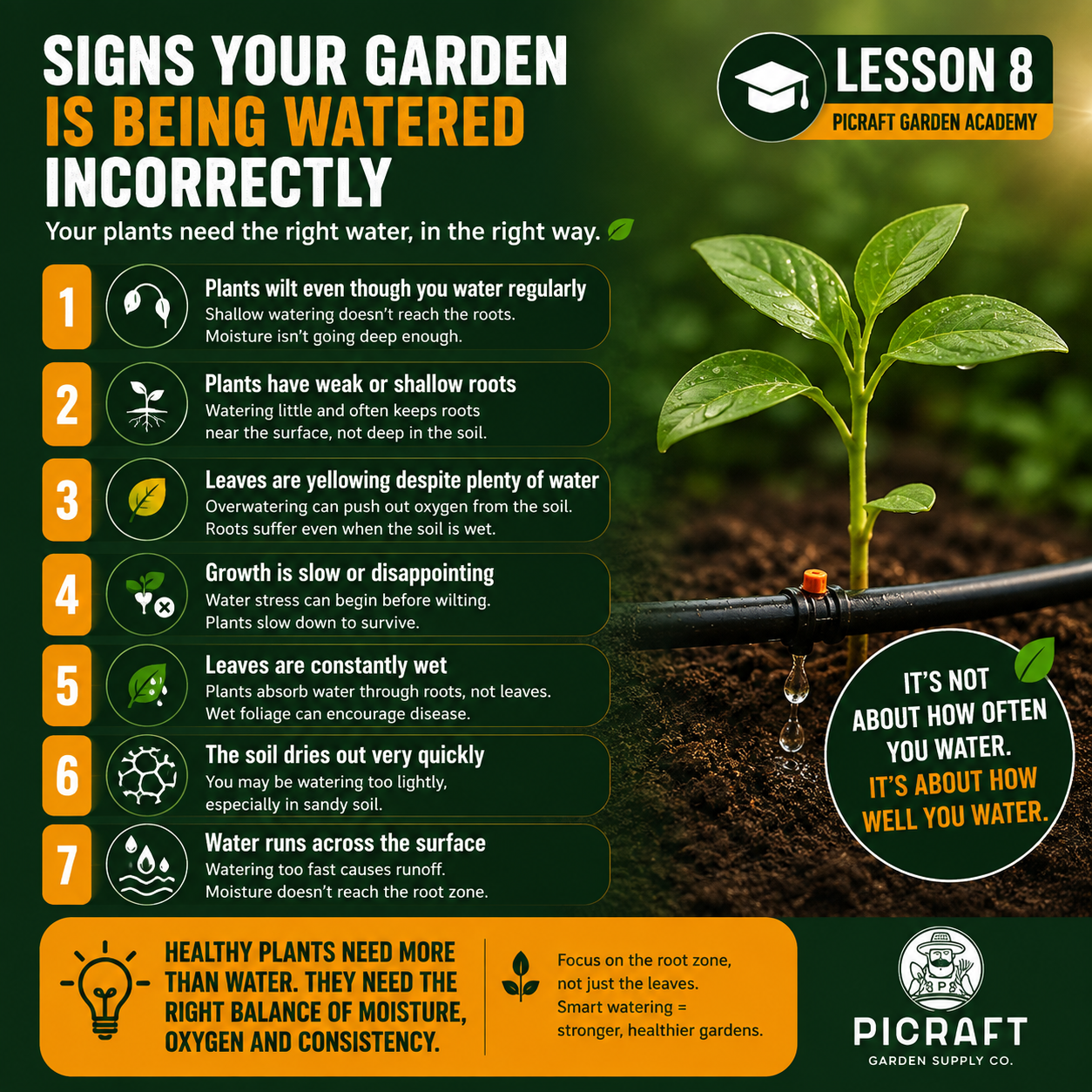
7 Signs Your Garden Is Being Watered Incorrectly
Watering seems like one of the simplest gardening tasks. Turn on the hose, fill the watering can or start the irrigation system and give your plants some water.
But healthy watering is more complicated than simply asking:
"Have I watered my plants?"
The more useful question is:
"Is enough moisture reaching the root zone, and are the soil conditions right for the plant?"
Many common garden problems can be caused not by a lack of water, but by how, when and where that water is being applied.
Plants can receive water regularly and still experience water stress. They can also suffer because they are receiving too much.
Here are seven signs that your garden watering routine may need adjusting.
Quick Answer: How Can You Tell If You're Watering Your Garden Incorrectly?
Common signs of incorrect watering include:
- plants wilting despite regular watering;
- weak or shallow root systems;
- yellowing leaves when the soil is consistently wet;
- slow growth or poor flowering;
- foliage remaining unnecessarily wet;
- soil drying very quickly after watering;
- water running across the surface rather than soaking into the ground.
The solution isn't always to give plants more water.
Successful garden watering is about maintaining appropriate moisture and oxygen levels around the root zone.
1. Your Plants Wilt Even Though You Water Regularly
Wilting is normally associated with a lack of water.
Naturally, the first reaction is often:
"I need to water more."
But that isn't always the correct solution.
If you frequently apply small quantities of water, only the upper layer of soil may become wet. The surface looks damp, but moisture may not penetrate far enough to reach deeper roots.
Repeated shallow watering can also encourage roots to remain close to the surface.
The Picraft Garden Academy explains this relationship clearly: frequent shallow watering encourages roots to stay near the surface, while deeper, more consistent watering encourages them to explore deeper soil where conditions are more stable.
What should you do?
Check the soil beneath the surface rather than judging moisture by appearance alone.
If only the first layer is wet, consider applying water more slowly and deeply so that moisture can penetrate further into the root zone.
2. Your Plants Develop Weak or Shallow Roots
Roots naturally respond to the availability of moisture.
If water is repeatedly available only near the surface, roots have less reason to grow deeper.
This can create a cycle:
shallow watering → shallow roots → soil dries quickly → plant needs watering again → more shallow watering.
The plant gradually becomes increasingly dependent on frequent watering.
Deeper watering can encourage roots to explore a larger volume of soil. The Picraft Garden Academy notes that deeper root systems can help plants tolerate heat, access nutrients from a larger volume of soil and survive longer periods without rainfall.
What should you do?
Where appropriate for the plant and soil, aim for less frequent but deeper watering rather than constantly wetting only the surface.
The objective isn't simply to use more water.
It's to get water to the right place.
3. Leaves Are Yellowing Even Though the Plant Gets Plenty of Water
This is where watering can become confusing.
Yellowing leaves may lead gardeners to assume a plant needs more water.
But if the soil is already constantly wet, adding more may make the problem worse.
Healthy roots require both water and oxygen.
Soil contains spaces that can hold both. When soil becomes excessively saturated for prolonged periods, water occupies more of those spaces and roots may have insufficient access to oxygen.
Our Garden Academy describes this as one of the reasons overwatering can sometimes be more damaging than temporary drought.
What should you do?
Before watering again, check the soil.
If it remains very wet, allow conditions to change rather than automatically adding more water.
Also remember that different soils drain at different rates.
4. Growth Is Slow, Flowers Are Poor or Harvests Are Disappointing
Not all water stress produces dramatic symptoms.
A plant doesn't necessarily have to collapse or visibly wilt before insufficient or inconsistent moisture begins affecting it.
This is particularly important because gardeners can easily miss hidden water stress.
The Picraft Garden Academy explains that repeated minor dehydration may allow a plant to survive while still reducing its performance. Growth can become uneven, flowers fewer and fruit production lower.
Water is involved in essential plant processes including nutrient transport, photosynthesis, temperature regulation and new growth.
What should you do?
Don't judge watering success solely by whether a plant is alive or visibly wilting.
Look at its overall performance:
- Is new growth healthy?
- Is flowering normal?
- Is fruit developing properly?
- Does the plant repeatedly struggle during warm weather?
The problem may be consistency rather than quantity.
5. The Leaves Are Constantly Wet
Plants don't need their leaves to be regularly soaked in order to absorb water.
Most water uptake takes place underground through the root system.
The Garden Academy explains that millions of microscopic root hairs provide a huge surface area for absorbing water and nutrients.
This is why good irrigation generally focuses on the root zone rather than the foliage.
Constantly wet leaves can also be undesirable because prolonged leaf wetness may favour certain fungal diseases, particularly in humid conditions.
What should you do?
Whenever practical, direct water towards the soil around the root zone.
Drippers, carefully positioned irrigation and controlled manual watering can achieve this more precisely than unnecessarily spraying the entire plant.
6. The Soil Dries Very Quickly After Watering
If your garden seems dry again shortly after watering, there are several possible explanations.
One is simply that you're not applying water deeply enough.
Another is your soil type.
Different soils behave very differently when water is applied.
Sandy soil
Sandy soil has relatively low water retention and good drainage. Moisture can move through it quickly, so smaller and more frequent applications may sometimes be appropriate.
Clay soil
Clay retains considerably more water and drains more slowly. It can benefit from slower, deeper irrigation with longer intervals between watering.
Loam
Loam provides a more balanced combination of moisture retention and drainage.
This is why there is no single watering schedule suitable for every UK garden.
What should you do?
Understand your soil before changing your watering schedule.
A routine that works perfectly in one garden may produce poor results in another only a few streets away.
7. Water Runs Across the Surface Instead of Soaking Into the Soil
If water is flowing across beds, borders or other areas rather than soaking into the soil, part of your irrigation is being wasted.
This can happen when water is applied faster than the soil can absorb it.
Instead of reaching the root zone, water may:
- run onto paths;
- collect in low areas;
- move away from the plants;
- evaporate from the surface.
The purpose of efficient irrigation is to maximise the benefit of the water applied by reducing unnecessary runoff and delivering moisture where plants can actually use it.
What should you do?
Try applying water more slowly.
Depending on the garden, drip irrigation or other forms of controlled application can allow moisture more time to penetrate the soil.
Don't Water According to the Calendar
One of the most common questions gardeners ask is:
"How many times a week should I water my garden?"
Unfortunately, there is no universal answer.
Water demand changes according to:
- rainfall;
- temperature;
- wind;
- cloud cover;
- soil type;
- plant species;
- plant maturity;
- season.
This is why a rigid schedule such as "every Tuesday and Friday" doesn't necessarily produce good irrigation.
The Academy's advice is simple:
Observe the soil.
Observe the weather.
Observe the plants.
Water when conditions require it, rather than simply because a particular day has arrived.
Don't Assume UK Rainfall Is Always Enough
The UK has a reputation for being wet, but annual rainfall doesn't tell the whole story.
Rainfall can be highly irregular. Several wet weeks may be followed by a prolonged dry period during spring or summer.
Heavy rainfall isn't necessarily ideal either.
A large quantity of rain falling quickly can produce runoff rather than penetrating deeply into the root zone.
A brief shower can create the opposite problem: the surface appears wet while the root zone remains comparatively dry.
So don't judge your garden's water requirements simply by whether it rained yesterday.
Check the soil.
Overwatering vs Underwatering: What's the Difference?
Both can damage plants, and sometimes the symptoms can be confusing.
| Possible sign | Underwatering | Overwatering |
|---|---|---|
| Wilting | Common | Can occur |
| Dry soil | Common | Unlikely |
| Constantly wet soil | No | Common |
| Yellow leaves | Possible | Possible |
| Shallow roots | Can develop | Roots may become unhealthy |
| Slow growth | Common | Common |
| Poor flowering/fruiting | Possible | Possible |
The key point is that symptoms alone don't always tell you whether more water is required.
Check soil moisture and consider the conditions around the root zone before changing your watering routine.
How to Check Whether Your Garden Actually Needs Water
You don't necessarily need expensive equipment.
Start by looking below the surface.
The top layer of soil can dry relatively quickly because it is exposed to sun and air, while deeper soil may still contain useful moisture.
Before watering:
1. Check beneath the surface.
Don't rely only on how the soil looks from above.
2. Consider recent rainfall.
Was it a meaningful soaking or just a short shower?
3. Think about your soil type.
Sandy and clay soils behave very differently.
4. Observe the plant.
Look for changes in growth and general condition, not only wilting.
5. Consider the weather.
Hot, windy conditions can increase water demand.
This moves you away from watering according to habit and towards watering according to conditions.
Why Consistency Matters More Than Simply Using More Water
One of the most important principles in garden irrigation is consistency.
Imagine soil that repeatedly moves between two extremes:
very dry → saturated → very dry → saturated.
The root system constantly has to adapt to changing conditions.
A well-managed watering routine aims to reduce these extreme fluctuations and provide more stable conditions within the root zone.
As explained in the Picraft Garden Academy:
Successful irrigation is about creating consistency.
Plants can tolerate changing conditions, but repeated dramatic changes in soil moisture can place them under unnecessary stress.
Frequently Asked Questions
How often should I water my garden?
There is no universal watering schedule. Frequency depends on soil type, weather, plant species and stage of growth. Check soil moisture and plant condition rather than watering automatically on fixed days.
Is watering every day bad for plants?
It can be. Frequent shallow watering can encourage roots to remain near the soil surface, making plants more dependent on regular watering.
Can you overwater a garden?
Yes. Roots require oxygen as well as moisture, so prolonged waterlogging can negatively affect plant health.
Is it better to water plants in the morning or evening?
Morning watering is generally preferred because evaporation is usually lower than during the hottest part of the day and foliage has time to dry. Evening watering isn't necessarily harmful, but prolonged wet foliage overnight can favour fungal diseases in susceptible plants.
Should I water the leaves or the soil?
Where possible, concentrate water around the root zone. Plants obtain water primarily through their roots, and unnecessarily wet foliage may increase the likelihood of some fungal diseases.
Is rain enough to water a UK garden?
Sometimes, but not always. Light rainfall may wet only the upper soil while deeper roots remain dry, and intense rainfall can produce runoff.
Is drip irrigation better than watering with a hose?
Neither method is universally better. Drip irrigation can deliver water more precisely and reduce waste, while a hose offers flexibility for occasional manual watering.
The Most Important Thing to Remember
Successful watering isn't about giving plants as much water as possible.
It isn't even primarily about how often you water.
What matters is the condition you're creating below the surface.
Healthy plants depend on healthy roots. Healthy roots require access to both moisture and oxygen, and different plants and soil types require different conditions.
So the next time your garden appears thirsty, don't immediately reach for the hose.
Check the soil.
Look at the plant.
Consider the weather.
And ask:
"What is happening around the roots?"
That simple change in thinking can completely change the way you water your garden.
Picraft Garden Academy – practical gardening knowledge for healthier plants, smarter watering and better gardens.