
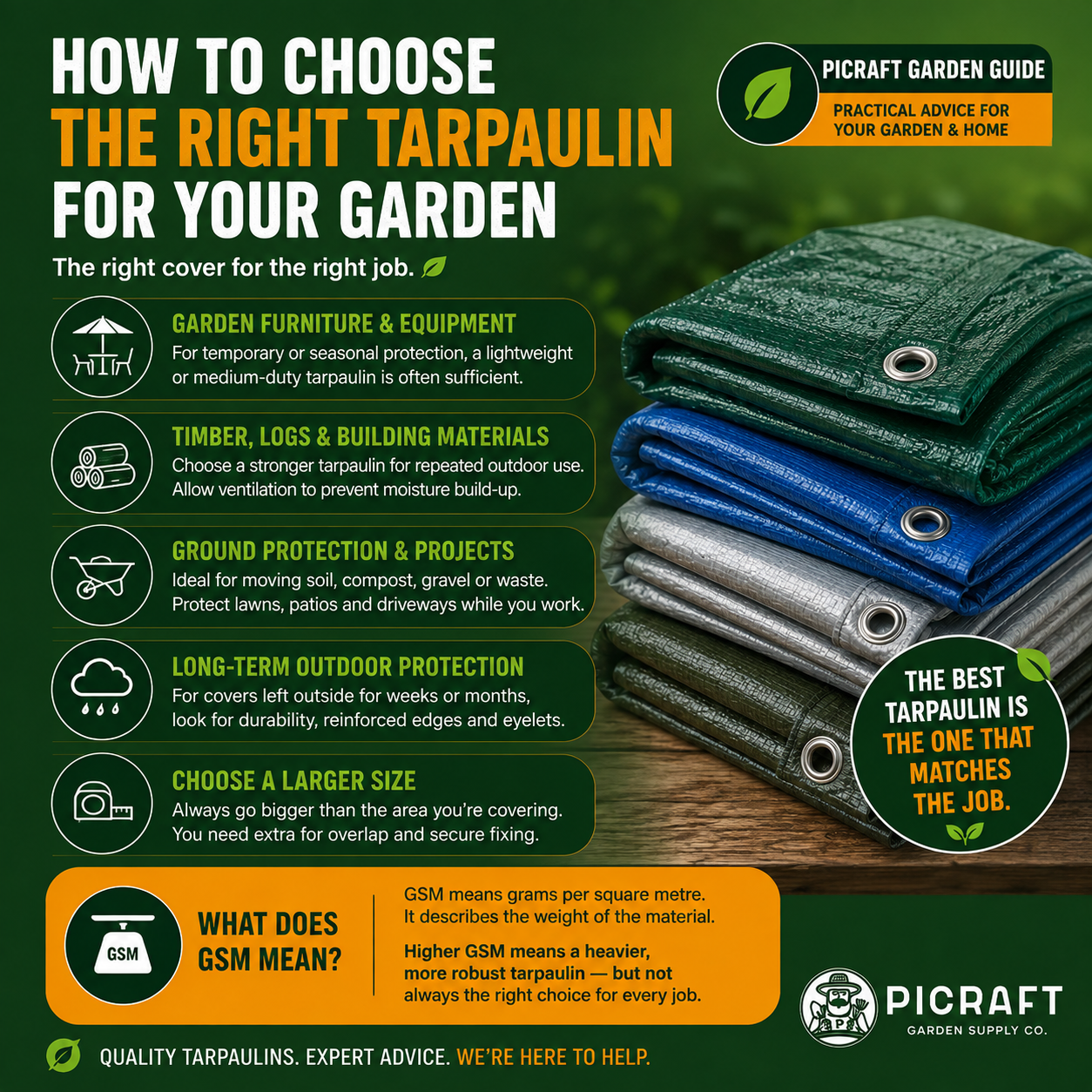
How to Choose the Right Tarpaulin for Your Garden
Tarpaulins are one of the most versatile pieces of equipment you can keep in a garden, shed, garage or workshop.
They can protect garden furniture from bad weather, cover logs and building materials, provide temporary ground protection, collect garden waste and help protect equipment stored outdoors.
But not every tarpaulin is suitable for every job.
Choosing the right tarpaulin isn't simply a matter of buying the thickest or heaviest cover available. The best choice depends on what you're protecting, how long it will remain covered, the conditions it will face and how the tarpaulin will be secured.
In this guide, we'll explain the most important things to consider before buying a garden tarpaulin, including GSM, sizing, eyelets, durability and common outdoor uses.
Quick Answer: Which Tarpaulin Do I Need?
For temporary garden jobs and light seasonal protection, a lightweight tarpaulin may be all you need.
For repeated outdoor use, covering equipment, timber or materials, a medium or heavier-duty tarpaulin will generally provide greater durability.
For longer-term outdoor protection, pay particular attention to:
- material weight (GSM)
- reinforced edges
- eyelets
- weather resistance
- how securely the cover can be fixed
- the size required for adequate overlap
The key is to match the tarpaulin to the job rather than simply choosing the highest GSM available.
What Does GSM Mean on a Tarpaulin?
One of the first specifications you'll see when comparing tarpaulins is GSM.
GSM stands for grams per square metre and describes the weight of the tarpaulin material.
For example, a 200 GSM material weighs approximately 200 grams per square metre.
As a general rule, a higher GSM tarpaulin is heavier and usually more robust than a lower GSM alternative. However, GSM shouldn't be the only factor you consider.
A lightweight tarpaulin can be much easier to:
- move
- unfold
- position
- carry
- store
For a quick garden project, using an unnecessarily heavy cover can actually make the job more difficult.
Conversely, if a tarpaulin will remain outdoors for an extended period or will regularly be handled, secured and exposed to bad weather, greater durability may be worthwhile.
Does higher GSM always mean a better tarpaulin?
No.
Higher GSM generally means more material per square metre, but the best tarpaulin is the one suited to its intended use.
Think of GSM as one part of the specification rather than a simple quality score.
Choosing a Tarpaulin for Garden Furniture
Tarpaulins can provide convenient temporary or seasonal protection for:
- garden tables
- chairs
- benches
- barbecues
- outdoor equipment
- garden tools
For occasional protection, a lightweight or medium-duty tarpaulin is often sufficient.
The important part is getting the size and fixing method right.
Avoid simply placing a loose tarpaulin over furniture and leaving it exposed to the wind. Movement can put unnecessary strain on the material and eyelets.
Where possible, secure the cover appropriately and avoid creating large areas where rainwater can collect.
Using Tarpaulins to Cover Logs and Timber
A tarpaulin can help protect firewood, timber and other materials from direct rain, but there is an important consideration:
Ventilation matters.
Completely wrapping damp timber in a waterproof cover can trap moisture rather than allowing it to escape.
For stored logs, it is often preferable to protect the top from rain while allowing sufficient airflow around the sides.
The objective isn't necessarily to create a completely sealed package. It's to achieve an appropriate balance between weather protection and ventilation.
Tarpaulins for Building and DIY Materials
Tarpaulins aren't limited to gardening.
They're also extremely useful for DIY, landscaping and building projects around the home.
They can provide temporary protection for materials such as:
- timber
- tools
- bags of materials
- landscaping supplies
- equipment awaiting installation
If the cover will be repeatedly moved or left outdoors for longer periods, consider a more robust tarpaulin with suitable reinforced edges and fixing points.
For construction and DIY applications, also consider what is underneath the cover. Some materials require ventilation and shouldn't simply be sealed underneath a tarpaulin for extended periods.
Using a Tarpaulin for Ground Protection
One of the most useful applications for a tarpaulin doesn't involve covering anything at all.
Instead, put it underneath your work area.
A tarpaulin can provide temporary ground protection when:
- moving soil
- emptying compost
- pruning trees and hedges
- repotting plants
- handling gravel
- clearing leaves
- mixing or moving garden materials
- carrying garden waste
For example, placing a tarpaulin beneath a hedge before trimming can make clearing up much easier. When the work is finished, the cuttings can be gathered together using the tarpaulin.
It can also help keep soil, compost and other loose materials away from patios and driveways.
This is one reason why having a general-purpose tarpaulin available in the shed can be surprisingly useful.
What Size Tarpaulin Should I Buy?
This is one of the easiest places to make a mistake.
If an object measures 2m × 3m across the top, that does not necessarily mean a 2m × 3m tarpaulin will cover it properly.
You also need material to extend down the sides and enough overlap to secure the cover.
Measure three things:
1. Length
Measure the full length of the object or area.
2. Width
Measure the full width.
3. Drop
If you're covering an object rather than a flat surface, decide how far the tarpaulin needs to extend down each side.
Add this to your required dimensions.
Example
Imagine you're covering a stack of materials measuring:
2m long × 1m wide × 0.5m high.
A 2m × 1m tarpaulin would only cover the top.
To cover the sides as well, you'll need additional material.
Whenever possible, allow some extra size for overlap and secure fixing.
Why Tarpaulin Eyelets Matter
Many tarpaulins have metal eyelets positioned around their edges.
These provide convenient fixing points for ropes, cords or other suitable securing methods.
However, eyelets should not be expected to compensate for poor installation.
A tarpaulin that repeatedly catches strong wind can experience considerable force.
Rather than concentrating excessive tension on one or two fixing points:
- use multiple fixing points where appropriate
- distribute tension around the cover
- avoid excessive flapping
- avoid sharp objects underneath the material
- don't overtighten the tarpaulin unnecessarily
Correct installation can make a significant difference to how well a tarpaulin performs.
Why Wind Is One of the Biggest Challenges
Rain may seem like the obvious enemy of an outdoor cover, but wind can be equally important.
A loose tarpaulin behaves like a sail.
Repeated movement can place stress on:
- corners
- edges
- eyelets
- the tarpaulin material itself
Before bad weather, check that outdoor covers remain properly secured.
For long-term applications, choosing a stronger tarpaulin is useful, but proper fixing remains essential regardless of GSM.
Should a Tarpaulin Be Completely Waterproof?
That depends on the application.
When protecting something from rainfall, water resistance is obviously important. But preventing rain from entering from above is only part of good outdoor storage.
Moisture can also accumulate underneath a cover through condensation or by trapping damp materials.
This is particularly important when covering:
- timber
- logs
- garden furniture
- machinery
- materials that were already wet
Always consider whether the covered item also requires air circulation.
A tarpaulin should protect the item without unintentionally creating a damp environment underneath.
Lightweight vs Heavy-Duty Tarpaulins
There is no single correct choice.
Lightweight tarpaulins are useful when:
- protection is temporary
- the cover needs to be moved frequently
- easy handling is important
- you're doing general garden work
- the tarpaulin will be stored between uses
Heavier tarpaulins may be preferable when:
- the cover will remain outdoors longer
- the tarpaulin will be used repeatedly
- greater durability is required
- materials or equipment require more substantial protection
- conditions are more demanding
Again, heavier doesn't automatically mean better.
Choose according to the application.
Common Tarpaulin Buying Mistakes
A few simple mistakes can dramatically reduce the usefulness of a tarpaulin.
1. Buying exactly the measured size
Remember to allow additional material for sides, overlap and fixing.
2. Choosing only by GSM
Material weight is important, but so are construction, size, intended use and fixing method.
3. Leaving a tarpaulin loose
Wind movement can put unnecessary strain on the cover.
4. Allowing water to pool
Try to position covers so that rainwater can drain rather than accumulating in large pockets.
5. Ignoring ventilation
Covering damp timber or equipment too tightly may trap moisture underneath.
6. Using one tarpaulin for every possible job
A lightweight cover for occasional garden work and a more robust cover for prolonged outdoor protection can serve very different purposes.
What Colour Tarpaulin Should I Choose?
For many practical garden applications, colour is largely a matter of preference, visibility and how noticeable you want the cover to be.
Green tarpaulins can blend more naturally into gardens and landscaped areas.
Blue tarpaulins are highly recognisable and easy to spot, making them popular for general-purpose applications.
Other colours may be useful where appearance, identification or visibility is important.
When choosing a tarpaulin, however, size, weight and suitability for the intended job should generally take priority over colour.
7 Practical Uses for Tarpaulins Around the Garden
A good general-purpose tarpaulin can be used for much more than simply covering furniture.
Try using one for:
- Protecting garden furniture from temporary bad weather.
- Covering logs and timber while maintaining ventilation.
- Collecting hedge and tree cuttings.
- Protecting patios and driveways during messy garden jobs.
- Moving leaves, compost and garden waste.
- Temporarily protecting landscaping and building materials.
- Covering garden tools and equipment when suitable permanent storage isn't immediately available.
Keeping one or two different sizes available can make many garden and DIY jobs considerably easier.
Frequently Asked Questions About Tarpaulins
What does GSM mean on a tarpaulin?
GSM means grams per square metre. It indicates the weight of the tarpaulin material. Higher GSM generally means a heavier, more robust material, although GSM alone doesn't determine which tarpaulin is best for a particular job.
What GSM tarpaulin do I need?
The appropriate GSM depends on how the tarpaulin will be used. Lightweight tarpaulins are convenient for temporary protection and general garden jobs, while heavier options are generally better suited to repeated or longer-term outdoor use.
How do I know what size tarpaulin to buy?
Measure the length and width of the area being covered and, when covering a three-dimensional object, account for the sides or "drop". Allow additional material for overlap and secure fixing.
Can I use a tarpaulin to cover garden furniture?
Yes. Tarpaulins can provide useful temporary and seasonal protection for garden furniture. Make sure the cover is appropriately sized and secured, and avoid allowing rainwater to collect on top.
Can I cover firewood with a tarpaulin?
Yes, but ventilation is important. Protecting the top of a log store from direct rainfall while allowing airflow around the sides can be preferable to completely wrapping damp firewood.
Can tarpaulins be used on building sites?
Tarpaulins are commonly useful for DIY, landscaping and building projects where temporary protection or ground covering is required. The appropriate size and material weight will depend on the application and conditions.
Are heavier tarpaulins always better?
No. Heavier tarpaulins may offer greater robustness, but they're also heavier to move and handle. For temporary or light-duty applications, a lighter tarpaulin may be more practical.
How do I stop a tarpaulin blowing away?
Use appropriate fixing points and distribute tension around the cover rather than relying on only one or two eyelets. Minimise loose material that can catch the wind and regularly check covers left outdoors.
Can a tarpaulin cause condensation?
Yes. Moisture can become trapped beneath a cover, particularly if the covered object was already damp or has insufficient ventilation. Consider airflow as well as protection from rainfall.
Choosing the Right Tarpaulin: Final Checklist
Before ordering, ask yourself:
What am I covering?
Furniture, logs, equipment, building materials or the ground?
How long will it stay covered?
A few hours, several days or an entire season?
What conditions will it face?
Rain, wind, repeated handling or prolonged outdoor exposure?
What size do I really need?
Remember the sides and fixing overlap.
How will I secure it?
Think about this before choosing the cover.
Do I need ventilation?
Particularly important for timber, logs and damp materials.
What GSM is appropriate?
Choose according to the job rather than automatically selecting the heaviest material.
The Right Cover for the Right Job
A tarpaulin is a simple product, but choosing the right one can make a significant difference.
The best tarpaulin isn't necessarily the biggest, thickest or heaviest option available. It's the one that provides the appropriate combination of size, durability, handling and protection for the job you're doing.
Whether you're protecting garden furniture, storing timber, working on a landscaping project or simply preparing for unpredictable British weather, taking a few minutes to choose the right cover can save time, reduce waste and protect your equipment and materials.
Explore Picraft's range of tarpaulins and garden supplies to find the right solution for your next garden, landscaping or DIY project.